
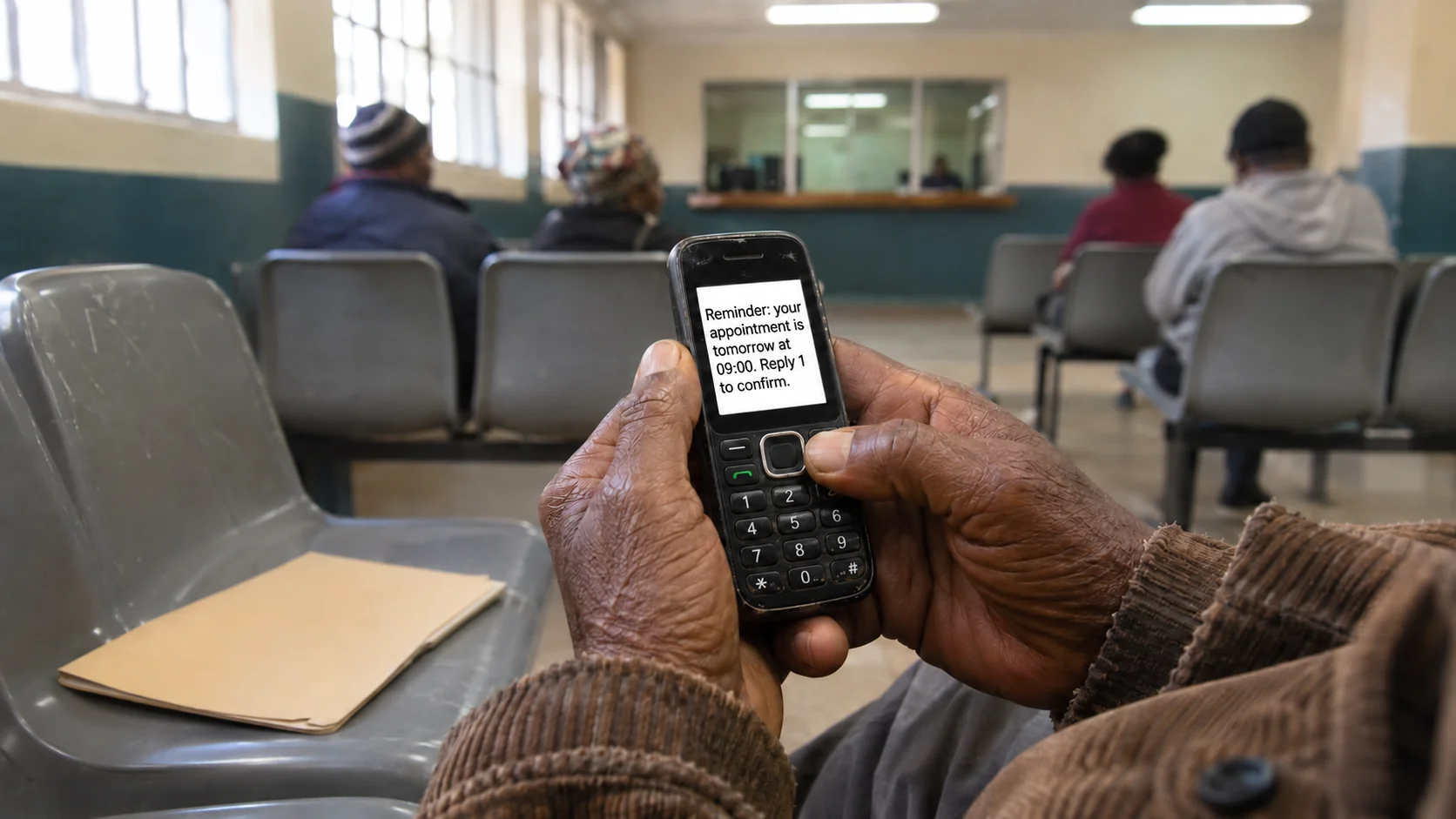
South Africans spent R1.5 billion less on text and multimedia messages in the year to September 2025 than in the year before. ICASA's 2026 State of the ICT Sector report found that messaging revenue fell from R4.1 billion to R2.6 billion, a drop of 37.9%, as people moved their conversations to WhatsApp, Telegram and Signal. ICASA said the decline was consistent with long-term substitution towards internet messaging and calling apps (TechCentral).
Read quickly, that sounds like the end of SMS. It is the end of SMS as the way people chat with each other. For businesses, the picture is different. Banks still send one-time PINs by SMS to millions of clients, even as they move towards in-app approval. Clinics send appointment reminders, schools send notices, municipalities send outage alerts, and prepaid electricity tokens are sent to customers' phones by SMS. Meanwhile, Meta changed how it charges businesses for WhatsApp messages in 2025, and fraud linked to SIM swaps has made banks rethink how much they rely on SMS at all.
This case study looks at what the numbers say about business messaging in South Africa, how banks, networks and Meta have changed the rules, and how a business should choose between SMS and WhatsApp for each kind of message.
The numbers at a glance
| Figure | Period | Source |
|---|---|---|
| Text and multimedia messaging revenue: down 37.9%, from R4.1 billion to R2.6 billion | 12 months to 30 September 2025 | TechCentral, on ICASA's report |
| Mobile voice traffic: up 21.5%; mobile services revenue down 7.9% to R121.9 billion | 12 months to 30 September 2025 | TechCentral, on ICASA's report |
| Digital banking fraud: 110,074 incidents, up almost 13%; losses up from R1.86 billion to R2.4 billion; mobile banking had the most SIM swap-related incidents | 2025 | BusinessTech, on SABRIC's statistics |
| WhatsApp Business Platform: per-message pricing replaces conversation-based pricing | From 1 July 2025 | Meta |
| Telkom WhatsApp bundles: R15 daily, R35 weekly, R100 monthly, including WhatsApp calls | Reported March 2026 | TechCentral |
| SIMcloud SMS: R0.23 per message part; 160 characters in one part | Current price | SIMcloud |
What happened to SMS
For two decades, SMS was how South Africans sent short messages. Prepaid bundles included SMSes, people counted them, and businesses used the same channel for notices and marketing. Smartphones and cheaper data changed that. WhatsApp became the default for personal messaging, and its calling feature took a share of voice calls too. Networks responded with WhatsApp and social bundles. In 2026 TechCentral reported that Telkom's WhatsApp bundles cost R15 a day, R35 a week and R100 a month and included calls inside the app, with terms that left some ambiguity about how calls used the bundle (TechCentral).
ICASA's figures show where the money went. Mobile operators carried more voice traffic than ever, up 21.5%, and earned less from mobile services, down 7.9% to R121.9 billion. Messaging revenue fell by more than a third in a year. Prepaid data revenue rose 7.7% to R42.1 billion. People have not stopped communicating; they now pay for it through data, and the apps they use do not pay the networks for each message.
The SMS that remains is increasingly business messaging: banks, clinics, retailers and utilities sending messages to people, sometimes called application-to-person or A2P messaging. That is why SMS remains a working business channel even as personal SMS fades.
Why businesses still send SMS
It reaches every phone
An SMS arrives on any mobile phone, smart or basic, with or without data, with or without an app installed. Pepkor's stores sell about eight in ten prepaid handsets in South Africa (TechCabal), and many prepaid customers have phones with limited storage or spend days without data. A clinic reminder or an electricity token sent by SMS reaches them anyway.
It needs no opt-in to an app
WhatsApp business messages reach only people who have WhatsApp and have agreed to receive messages from the business. SMS reaches any valid number. For operational messages that a customer needs, such as a delivery update or a token, that matters.
It works when data does not
During load-shedding, network congestion or when a prepaid customer has run out of data, an SMS still arrives. Many businesses send critical messages by SMS for that reason, even if they prefer WhatsApp for conversations.
It is simple to send and to cost
An SMS has a fixed price per part. A business can send one from a dashboard, a spreadsheet or a few lines of code, without template approval or a business verification process. At SIMcloud, one message part costs R0.23.
Banks, one-time PINs and SIM swaps
For years the largest business use of SMS in South Africa has been banking: one-time PINs to approve payments and logins, and transaction notifications. That use is under pressure, because criminals have learned to take over a victim's phone number.
In a SIM swap, a criminal persuades a network to move a victim's number to a new SIM, or exploits a weakness in the process, and then receives the victim's SMS messages, including bank PINs. SABRIC, the banking industry's crime information centre, reported 110,074 digital banking fraud incidents in 2025, up almost 13%, with losses rising from R1.86 billion to R2.4 billion, and found that mobile banking recorded the highest number of SIM swap-related incidents (BusinessTech; Business Report).
Banks have responded by moving approvals into their apps. Capitec and FNB, among others, let clients approve transactions inside the banking app instead of typing an SMS PIN. Industry commentators argue for device-bound authentication and passkeys, while noting that many South Africans do not yet have phones that support passkeys (ITWeb). SMS PINs remain in use at some stage of most banks' processes, especially for clients without smartphones, but their role is shrinking for high-value approvals.
The lesson for other businesses is specific. SMS is a good channel for telling someone something. It is a weaker channel for proving who someone is, because a phone number can be taken over. Businesses that use SMS codes for logins or payments should treat them as one factor among several, check for recent SIM swaps where networks offer that check, and avoid sending anything by SMS that would let a criminal take money if intercepted.
WhatsApp's pricing change
Businesses that message customers on WhatsApp at scale use the WhatsApp Business Platform, usually through a provider. On 1 July 2025, Meta moved the platform from conversation-based pricing to per-message pricing for template messages, the messages a business starts with a customer (Meta). Rates differ by country and by category: marketing, utility and authentication messages are priced differently, and volume tiers apply to some categories. Meta also lowered authentication-international rates for South Africa from 1 April 2025.
The practical effect is that WhatsApp is no longer free at scale for businesses, and its cost depends on what the message is for. Published third-party rate tables put South African authentication messages at under one US cent each before provider fees, with sources differing on the exact figure and rates changing over time. Marketing messages cost more. Messages sent in reply to a customer within the customer service window are treated differently from messages the business starts. A business comparing channels should look at its provider's current rate card for each category, add the provider's own fees, and compare that with the price of SMS parts for the same message.
WhatsApp has real advantages: rich media, read receipts, a conversation the customer can reply to easily and a verified business profile. It also has requirements: message templates must be approved, the business must be verified, and customers must have opted in.
Choosing between SMS and WhatsApp
Most businesses do best with both, using each for what it does well.
| Message | Better channel | Why |
|---|---|---|
| Prepaid electricity token or voucher code | SMS, optionally also WhatsApp | Must reach any phone, with or without data |
| Appointment reminder from a clinic or school | SMS | Reaches basic phones and people without data |
| Outage or emergency alert | SMS | Works when data or apps do not |
| Delivery update with a tracking link | WhatsApp or SMS | WhatsApp shows rich content; SMS reaches everyone |
| Customer service conversation | Two-way, media, conversation history | |
| Login or payment approval | In-app approval, with SMS only as one factor | Phone numbers can be taken over through SIM swaps |
| Marketing to opted-in customers | Either, depending on audience and cost | Compare rates; both need consent and an opt-out |
The test is simple. If the message must reach the person whatever phone they have and whether or not they have data, send an SMS. If the message starts or continues a conversation with a customer who uses WhatsApp, use WhatsApp.
What an SMS really costs
The headline price of an SMS is per part. One standard SMS holds 160 characters. Longer messages are split into parts and joined on the phone, and each part is billed: at SIMcloud's price of R0.23 a part, a message of 161 to 306 characters costs R0.46, and one of 307 to 459 characters costs R0.69 (SIMcloud).
Special characters change the arithmetic. A message that contains an emoji or certain non-standard characters is sent in a different encoding that fits far fewer characters per part, so a message that looks short can become two or three parts. Curly quotation marks pasted from a word processor can have the same effect. Writing messages in plain text, checking the character count before sending and keeping the core message within 160 characters keeps costs predictable.
The other cost is wasted messages: messages sent to numbers that no longer exist, to people who opted out or to lists that contain duplicates. Cleaning a list before a bulk send usually saves more than negotiating a lower price per message.
Writing a business SMS that works
An SMS is read on a lock screen in a few seconds, so it has to say who it is from, what it is about and what to do, in that order. Start with the sender's name, because a message from an unknown number is often ignored or treated as a scam. Put the single most important fact next: the appointment time, the outage window, the amount due or the token. End with the action and, for marketing, the opt-out.
Three short examples show the pattern, using an invented business:
- "Sunrise Clinic: your appointment is on Tue 14 Oct at 09:30. Reply 1 to confirm or 2 to rebook."
- "Sunrise Estates: water off in Block C on Thu from 10:00 to 14:00 for repairs. Sorry for the inconvenience."
- "Sunrise Store: 20% off school shoes this weekend only. Reply STOP to opt out."
Each fits in one part. None contains a link a customer would need to trust blindly, an emoji that would change the encoding or a request for personal information. Scammers imitate business SMS, so legitimate businesses should never ask for PINs, passwords or banking details by SMS, and can say so in their messages and on their websites.
What delivery reports tell you
When a business sends an SMS through a provider, the network returns a delivery status. "Delivered" means the handset accepted the message. It does not mean the person read it. "Failed" usually means the number is invalid, switched off for too long or unable to receive messages. A message can also remain pending while a phone is off, and be delivered when it is switched on.
Delivery reports are useful for list hygiene. Numbers that fail repeatedly should be checked or removed. A sudden rise in failures on one network may point to a problem worth raising with the provider. And for critical messages, a failed status is a signal to try another channel, such as a call or a WhatsApp message to a customer who uses it.
A worked example: clinic reminders
The example below uses stated assumptions. It does not describe any real clinic.
Assume a private clinic sends 2,000 appointment reminders a month. Each reminder is written to fit in one 160-character part, and the clinic sends one reminder two days before each appointment. At R0.23 a part, the month's reminders cost R460. If the clinic added an emoji to every message and pushed each into two parts, the cost would double to R920 with no benefit to patients.
The clinic sends reminders by SMS because some patients have basic phones and some have no data on the day the reminder goes out. It uses WhatsApp for patients who message the clinic first with questions, because a conversation with photos of documents works better there. It reviews delivery reports weekly and calls patients whose reminders failed. The choice of channel follows the patient, not the clinic's preference.
The rules for business messages
South African law treats operational messages and marketing differently.
Operational messages, such as a delivery notice, an appointment reminder, a token or an account alert, are part of the service a customer signed up for. They still involve personal information, so POPIA's general conditions apply: collect numbers for a purpose, keep them secure and use them for that purpose.
Direct marketing by electronic communication, including SMS and WhatsApp, has stricter rules. Under section 69 of POPIA, a business may send electronic direct marketing to a person only with their consent, or to an existing customer for similar products or services if the customer was given a chance to opt out when their details were collected and is given one in every message. Every marketing message should identify the sender and include a way to opt out, such as "Reply STOP to opt out".
The Consumer Protection Act regulations also restrict when direct marketing may reach a consumer at home: not on Sundays or public holidays, not on Saturdays before 09:00 or after 13:00, and not on other days before 08:00 or after 20:00, unless the consumer has agreed otherwise in writing (Consumer Protection Act regulations). In April 2026 government published amendment regulations that strengthen direct marketing rules and provide for an opt-out registry (Cliffe Dekker Hofmeyr). Businesses that send marketing by SMS should check their processes against the amended rules.
Our bulk SMS guide explains these rules in plain language for small businesses.
What the shift teaches
Channels decline for some uses and survive for others
Personal SMS collapsed; business SMS for reach, alerts and tokens did not. When a channel loses its mass use, look at which specific jobs it still does better than anything else.
Price follows purpose
Meta now prices WhatsApp by message category. SMS is priced per part. The cheapest channel depends on what the message is for and how long it is.
Reach and security are different questions
SMS reaches almost everyone, which is why banks used it for PINs, and its weakness as proof of identity is why banks are moving away from it for approvals. Choose channels for what each message needs to do.
Rules are tightening
POPIA, the Consumer Protection Act and its 2026 amendments, and Meta's own policies all push businesses towards consent, clear identification and easy opt-outs. Businesses that build those in from the start avoid complaints and penalties.
What this means for your business
A business that sends messages to customers should map each message type to a channel, as in the table above, and review the choice once a year as prices and customer habits change. For most businesses, that means SMS for critical operational messages that must reach everyone, WhatsApp for conversations and rich updates, in-app approvals for security, and careful, consented marketing on whichever channel the audience prefers.
Businesses that sell prepaid have a particular reason to keep SMS. An electricity token, a voucher code or a confirmation that airtime has been loaded must reach the customer's phone reliably, including basic phones without data. SIMcloud sends prepaid electricity tokens to customers by SMS for the same reason.
Build it: SMS in your own systems
SIMcloud's SMS API lets your system send a message and query its delivery status by the identifier returned when the message is queued. Use it for appointment reminders from a booking system, alerts from a monitoring system, codes and confirmations from an app or tokens and receipts from a prepaid platform. Our Node.js SMS guide shows a working integration. Each message part costs R0.23, with no monthly fee, and tax invoices are generated monthly with a report of every transaction.
Send it: bulk SMS from a spreadsheet
For notices and campaigns, SIMcloud lets you upload a spreadsheet of recipients and messages, check the cost before sending, and review delivery status for each message afterwards. Message history shows replies from recipients, so you can see opt-out requests and answer questions. Saved templates keep regular messages consistent. Our guide to sending bulk SMS walks through the process, including the message-length table and compliance checks.
Timeline
- April 2025: Meta lowers authentication-international WhatsApp rates for South Africa.
- 1 July 2025: Meta moves the WhatsApp Business Platform to per-message pricing.
- September 2025: The year covered by ICASA's 2026 report ends, with messaging revenue down 37.9%.
- March 2026: TechCentral reports on Telkom's WhatsApp bundles and their terms.
- April 2026: ICASA's State of the ICT Sector report is published. Government publishes Consumer Protection Act amendment regulations on direct marketing.
- 2026: SABRIC reports 2025 digital banking fraud losses of R2.4 billion, with SIM swaps prominent in mobile banking fraud.
Frequently asked questions
Is SMS dead in South Africa?
Personal SMS has declined sharply, with messaging revenue down 37.9% in a year. Business SMS is still widely used for tokens, reminders, alerts and notices because it reaches every phone, with or without data.
Is WhatsApp cheaper than SMS for businesses?
It depends on the message category, the volume and the provider's fees. Since July 2025 WhatsApp charges per message by category. Compare your provider's current rates with the cost of SMS parts for the same message.
Why are banks moving away from SMS PINs?
Criminals use SIM swaps to receive victims' SMS messages, including bank PINs. SABRIC found mobile banking had the most SIM swap-related fraud incidents in 2025, so banks are moving approvals into their apps.
How many characters fit in one SMS?
160 standard characters. Longer messages are split into parts, each billed separately. Emojis and some special characters reduce the number of characters per part.
When may I send marketing SMS?
Under the Consumer Protection Act regulations, not on Sundays or public holidays, not on Saturdays before 09:00 or after 13:00, and not on other days before 08:00 or after 20:00, unless the consumer has agreed otherwise in writing. You also need consent or an existing customer relationship under POPIA, and an opt-out in every message.
Can I see whether my SMS was delivered?
Yes. SIMcloud records delivery status for each message in your history and through the API. Delivered means the handset accepted the message; it does not show whether the person read it.
Sources
- TechCentral: WhatsApp is eating South African operators' revenue (4 April 2026)
- ICASA: The State of the ICT Sector Report of South Africa, 2026
- TechCentral: How a WhatsApp bundle exposed a fault line in SA mobile (19 March 2026)
- Meta: Pricing on the WhatsApp Business Platform
- BusinessTech: R2.4 billion stolen from South Africans
- Business Report: Most mobile banking fraud linked to SIM swaps (30 April 2026)
- ITWeb: Passkeys are gaining ground, but SA's device gap remains a hurdle
- TechCabal: 8 out of 10 prepaid phones bought at Pepkor stores (27 May 2025)
- Consumer Protection Act: Prohibited times for contacting consumers
- Cliffe Dekker Hofmeyr: South Africa tightens direct marketing regulations (July 2026)
Figures are as published by the organisations or reported by the outlets linked above, for the periods stated. WhatsApp rates change; check your provider's current rate card. This article is general information, not legal advice. SIMcloud is not affiliated with Meta, WhatsApp, any network or any bank named.