
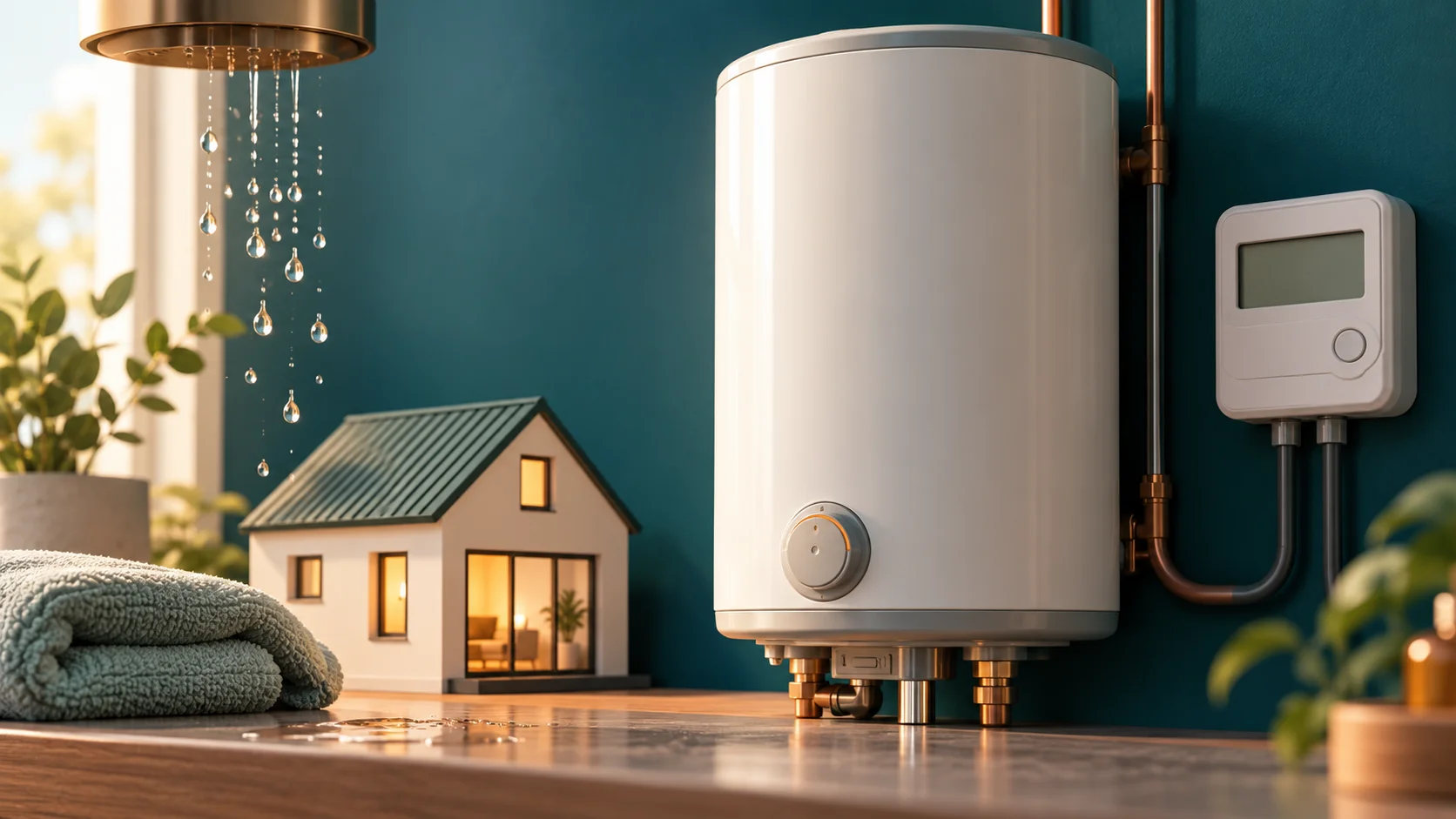
A geyser's cost depends on the electricity used to heat replacement water and cover heat losses, not simply its storage capacity. A 3 kW element running for three equivalent full-power hours uses 9 kWh. At an illustrative flat R3.50/kWh, that is R31.50 for the day. These are assumptions, not a measured average for every 150-litre geyser.
Calculate your geyser's actual running cost
Use the appliance calculator with either measured daily kWh or the element's electrical input and actual heating hours. Do not enter 24 hours merely because the geyser remains connected. The thermostat switches the element according to water temperature and demand.
For an individual household, a suitable installed energy monitor over representative days is a better basis than a generic daily-use claim. Hardwired equipment requires appropriate measurement and qualified assistance. A normal household plug meter is not automatically suitable for a geyser circuit.
What does heating 150 litres require?
As a physics example, heating 150 litres of water from 10°C to 60°C needs about 8.72 kWh of heat: 150 × 4.186 × 50 ÷ 3,600. This assumes water mass of approximately 1 kg/litre and excludes tank/pipe losses. It describes one full-volume temperature rise, not daily household consumption.
At 3 kW input, the ideal heating time for that example is about 2.91 hours. A household may replace only part of the stored hot water, draw water repeatedly or incur additional losses. Mixing with cold water also changes the volume delivered at a tap. Capacity alone cannot establish a daily bill.
A monthly comparison with explicit assumptions
| Equivalent element operation | Daily kWh | 30-day kWh | At illustrative R3.50/kWh |
|---|---|---|---|
| 3 kW × 2 hours/day | 6 | 180 | R630 |
| 3 kW × 3 hours/day | 9 | 270 | R945 |
| 3 kW × 4 hours/day | 12 | 360 | R1,260 |
Use your own rate and measured operating pattern. The tariff hub explains why some households need a block calculation and why fixed charges should not be assigned to each appliance independently.
Why consumption changes
Record the amount of hot water used, incoming water conditions, reheating cycles, leaks and standing losses. More showers or colder incoming water can change heating demand even when the thermostat setting and element stay the same. Compare periods with similar occupancy and habits.
A timer changes when heating is available; it does not remove the energy needed to warm the water used. Its effect on cost depends on losses, usage and whether the tariff changes with time. Do not promise a percentage saving from a timer without measuring the installation. Ask a qualified installer about thermostat, insulation and timer changes that suit the equipment.
A practical measurement record
- Record the element input rating and any existing timer schedule.
- Measure kWh over representative days using suitable equipment.
- Note occupancy, showers, unusual draws and outages.
- Change one controllable factor with appropriate advice.
- Compare matched periods and retain the assumptions with the result.
Whole-house prepaid balance changes include cooking, pumps, refrigeration and other loads. They are not a clean geyser measurement unless those other loads are accounted for. Electricity purchased is also different from electricity consumed during the measurement period.
Geyser questions
Does a bigger element always cost more?
Power and heating time both matter. Compare energy for the same heating task and losses, not watts alone.
Can every 150-litre geyser be assigned one daily-use figure?
No. Draw-off, temperature rise, insulation, losses and control determine use. Treat generic figures as scenarios until measured.
Method references: Eskom residential-calculator assumptions and the energy advisory guidance. Reviewed 1 November 2026; example rates are illustrative.