
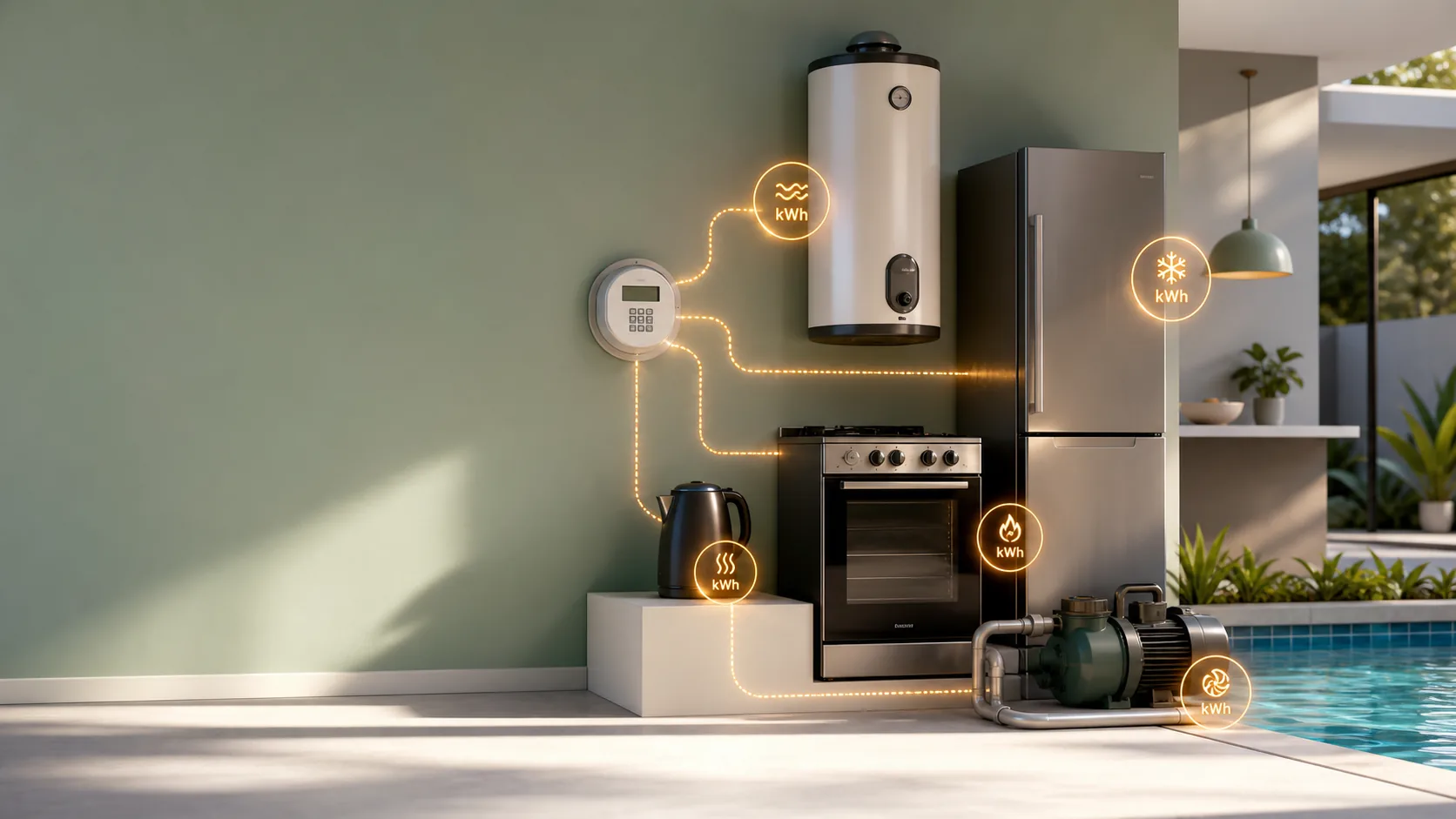
You loaded 100 units, and four days later the meter is beeping. Before blaming the meter or the municipality, it is worth knowing what actually eats those units, because household electricity is astonishingly lopsided: one or two appliances typically account for more than half of everything you buy.
A quick refresher: one unit on your meter is one kilowatt-hour (kWh). A 1,000 watt appliance running for one hour uses one unit. A 2,000 watt appliance uses one unit in half an hour. That single conversion explains every figure below.
The numbers that follow are typical ranges for common South African household appliances. Your exact figures depend on the appliance's size and age, your settings and your habits, but the ranking barely changes from one home to the next.
The big three
Geyser: roughly 8 to 12 units per day. The standard 150 litre geyser has a 2 to 3 kW element that works hard to keep water hot around the clock. In most homes without solar, the geyser alone is 40 to 60 percent of the electricity bill. Winter is worse because the incoming water is colder and the losses are bigger.
Stove and oven: roughly 2 to 4 units per day of cooking. Oven elements draw 2 to 3 kW and hobs 1 to 2 kW per plate. An hour of oven plus two plates going is easily 4 units.
Heating and cooling: 1 to 2.5 units per hour of use. A 2,000 watt heater uses 2 units every hour it runs. Run it for five winter evenings hours and that is 10 units a day, which is why winter buying always feels worse. Air conditioners vary widely, but a mid-size unit draws 1 to 2.5 units per hour in heating mode.
Everything else
| Appliance | Typical usage |
|---|---|
| Fridge/freezer | 1 to 1.5 units per day, always on |
| Kettle | 0.1 to 0.2 units per boil |
| Washing machine (cold wash) | 0.3 to 0.5 units per load |
| Washing machine (hot wash) | 1 to 2 units per load |
| Tumble dryer | 2 to 3 units per load |
| Dishwasher | 1 to 2 units per load |
| Microwave | 0.6 to 1.2 units per hour of use |
| Iron | 1 to 2 units per hour of use |
| Pool pump | 0.75 to 1.1 units per hour, often 6+ hours a day |
| TV | 0.05 to 0.15 units per hour |
| Lights (LED, whole house) | 0.2 to 0.5 units per evening |
| Wi-Fi router | about 0.2 units per day |
| Phone charging | about 0.01 units per charge |
Two things jump out of that table. First, the things people feel guilty about (lights, TV, phone charging) are rounding errors. Second, anything that makes heat (geyser, stove, heater, kettle, iron, tumble dryer) dominates everything else. Heat is expensive; electronics are cheap.
A pool deserves its own mention: a pump running 8 hours a day is 6 to 9 units daily, every day, which can quietly rival the geyser over a month.
Where your units go: a typical month
For a family home with a geyser and no pool, a rough monthly picture looks like this:
- Geyser: 250 to 350 units
- Cooking: 60 to 120 units
- Fridge/freezer: 30 to 45 units
- Laundry and dishes: 30 to 60 units
- Lights, TV, electronics: 20 to 40 units
- Winter heating: 0 to 300 units, the seasonal wildcard
Which is why a household buying 450 units a month in summer can suddenly need 700 in July without anyone doing anything wrong.
Making your units last longer
Ordered by impact, not effort:
1. Attack the geyser. Set the thermostat to 60°C, fit a geyser blanket and insulate the first metre of the outlet pipe, and put the geyser on a timer so it heats twice a day instead of all day. Together these commonly cut geyser consumption by 20 to 40 percent, worth 60 to 130 units a month. Shorter showers multiply the effect.
2. Contain winter heating. Heat the person, not the room: an electric blanket uses around 0.1 units per hour against a heater's 2 units. If you do heat a room, close it off and use a thermostat-controlled heater.
3. Cook smarter. The microwave, air fryer and pressure cooker all deliver the same meal for a fraction of the oven's units. Boil only the water you need; a full kettle for one cup doubles the cost of every cup.
4. Cold wash, line dry. Most of a hot wash's cost is heating the water, and the tumble dryer is 2 to 3 units per load that the washing line does for free.
5. Cut the pool pump's hours. Most pools stay clean on 4 to 6 hours a day; many pumps are set to 8 or more out of habit.
6. Ignore the small stuff. Unplugging the TV standby light saves cents. Spend your attention where the units are.
Track it with your meter, and buy at the right time
You do not need a gadget to measure any of this. Your prepaid meter is the measuring tool: note the balance before and after running an appliance and the difference is its real consumption. The keypad codes for reading your balance are here.
And once you know your real monthly usage, the other half of the saving is buying correctly: in most municipalities the price per unit climbs the more you buy in a month, so a predictable early-month purchase pattern gets you more units for the same rand. That mechanism, and the buying pattern that beats it, is covered in why you get fewer units for the same money. If your usage is stable, a scheduled monthly purchase makes the whole thing automatic.
FAQ
How many units does a geyser use per day?
Typically 8 to 12 units for a standard 150 litre geyser, more in winter. It is usually the single biggest consumer in the house, at 40 to 60 percent of total usage.
How many units does a fridge use per day?
A modern fridge/freezer uses roughly 1 to 1.5 units per day. Older or badly sealed units can use double that.
Why do my units run out so fast in winter?
Colder incoming water makes the geyser work harder, and any electric heating adds 1 to 2 units per hour of use. A household's winter consumption is commonly 30 to 60 percent higher than summer.
Does leaving appliances on standby use a lot of units?
No. Standby consumption across a whole house is typically a few units a month. Focus on heat-producing appliances instead.
How can I check what an appliance uses without a meter plug?
Read your prepaid meter balance, run only that appliance for a set time, and read the balance again. The difference is its consumption for that period.
Know your number, then automate it. Create a free SIMcloud account and schedule your monthly purchase for the first week of the month, when your units are cheapest.