
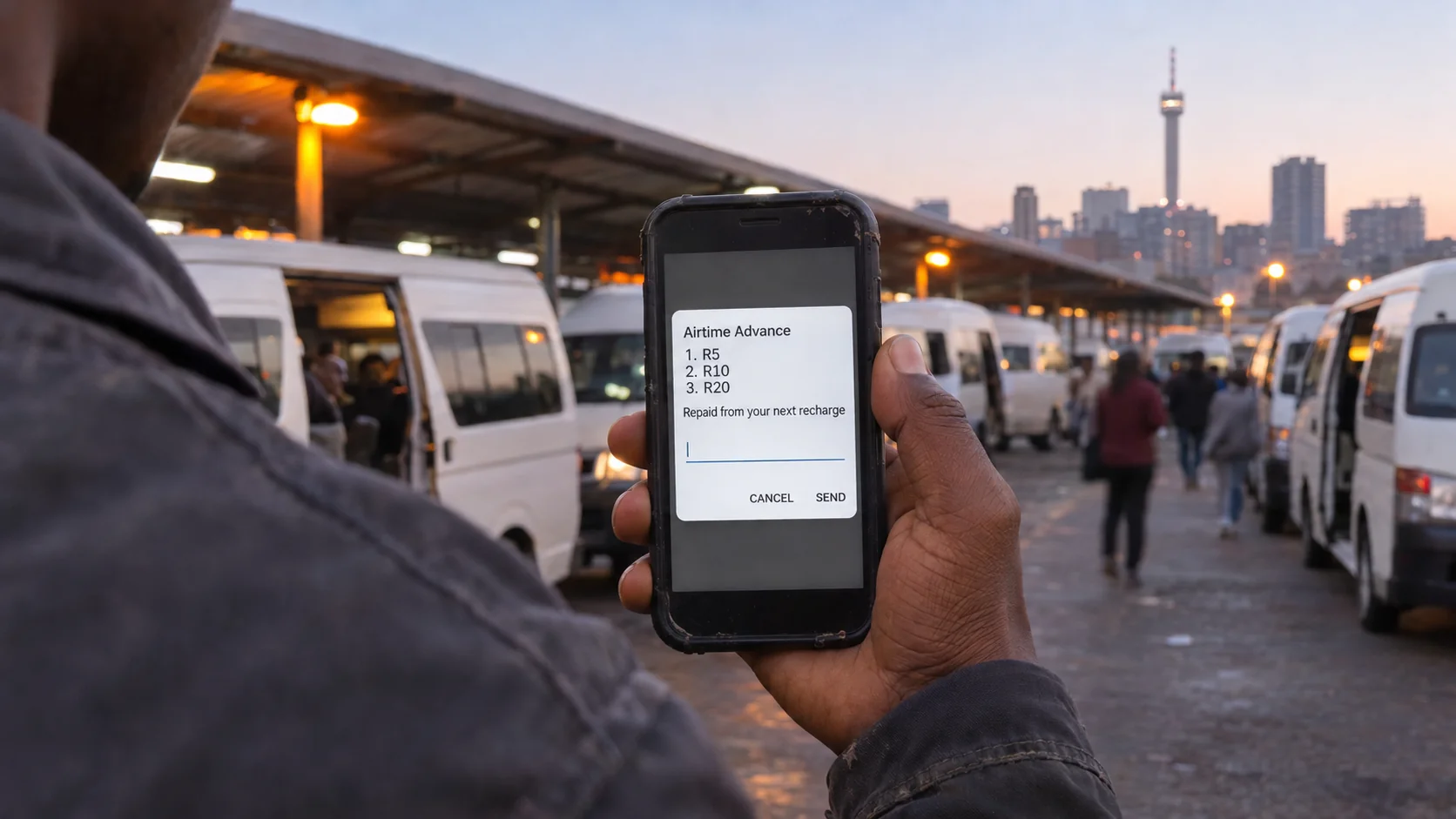
About half of all prepaid recharges on Vodacom's South African network in the year to March 2026 were airtime advances. That is the figure Vodacom disclosed in its integrated report in June 2026, as TechCentral reported (TechCentral). Half of the time a Vodacom prepaid customer's balance was topped up, the airtime came on credit, to be repaid from the next recharge.
Over the same period MTN went the other way. It cut the share of its prepaid recharges funded by airtime credit from 42% to about 34%, and said the reset cost it 1.1 million prepaid customers in a single quarter. "We want a base that's less dependent on airtime credit," MTN's chief executive said. Meanwhile Optasia, a company that builds airtime credit and micro-lending systems for mobile operators, listed on the JSE in November 2025 at an implied value of R23.5 billion, and Capitec, Nedbank, FNB and Lesaka have all added advances of their own.
Running out of airtime before payday is common enough to support an industry. This case study explains how airtime advances work, what they cost, how large the market has become, why one network is cutting back while others lean in, and what employers and organisations can do so their people need advances less often.
The numbers at a glance
| Figure | Period | Source |
|---|---|---|
| Vodacom: Airtime Advance about half of South African prepaid recharges | Year to March 2026 | TechCentral, citing Vodacom's integrated report |
| Vodacom: R12.8 billion of airtime advanced, 44.7% of airtime volumes | Financial year 2023 | TechCentral |
| MTN South Africa: airtime credit cut from 42% to about 34% of prepaid recharges; 1.1 million prepaid customers lost in the second quarter | Year to mid-2026 | TechCentral |
| MTN South Africa fintech revenue, including XtraTime: down 16.3% to R701 million | Six months to June 2026 | TechCentral |
| Telkom: airtime advance 24.7% of prepaid recharges, across 4.4 million active users | Reported 2026 | TechCentral |
| Optasia JSE listing: R19.00 a share, implied market capitalisation R23.5 billion | November 2025 | JSE |
| Optasia revenue: up 76% to US$265.4 million; users up 43% to more than 432 million | Year to December 2025 | Optasia |
| Capitec airtime advances: R97.3 million in the first financial year; limit later raised from R10 to R100 | Year to February 2026; 2026 | BusinessDay; TechCentral |
How an airtime advance works
An airtime advance lets a prepaid customer with an empty or low balance borrow a small amount of airtime, data or minutes, and repay it automatically from their next recharge. The customer usually requests it by USSD code, in the network's app or, increasingly, in a banking app.
Eligibility is decided by the lender's systems, based on how the customer has used and recharged their line. A customer who has been on the network for some time and recharges regularly can usually borrow more than a new customer. The amounts are small: networks have typically offered advances from a few rand up to a few hundred rand, and Capitec launched its cross-network airtime advance with a R10 limit before raising it to R100.
Each advance carries a fee. In 2023, TechCentral reported that Vodacom, Telkom and Cell C charged an access fee of R1.10 per advance, while MTN charged R1.10 for every R10 advanced or part thereof, and that Vodacom's advances had to be repaid within 30 days (TechCentral). Capitec's 2026 fee schedule lists an airtime advance fee of R1.00 and a Capitec Connect advance fee of R0.80 (Capitec). Fees and limits change, so check each provider's current terms.
Repayment is the simplest part. When the customer next recharges, the advance and fee are deducted from the new airtime before the rest becomes available. For a bank advance, the amount is recovered from the client's next deposit.
What an advance costs, in plain arithmetic
A flat fee looks small in rands and large as a share of a small advance. The table shows the fee as a percentage of the amount borrowed, using the fees reported above. It makes no assumption about how long the advance is outstanding.
| Advance | Flat R1.10 fee | Fee of R1.10 per R10 or part | Flat R1.00 fee |
|---|---|---|---|
| R5 | 22% | 22% | 20% |
| R10 | 11% | 11% | 10% |
| R20 | 5.5% | 11% | 5% |
| R50 | 2.2% | 11% | 2% |
| R100 | 1.1% | 11% | 1% |
Two things follow. Under a flat fee, small advances are by far the most expensive per rand borrowed, and small advances are the ones people take most often when money is tightest. Under a fee charged per R10, the percentage stays the same at every size. A customer who takes several small advances in a month can pay a noticeable share of their airtime spending in fees without ever seeing a large number on a statement.
Defenders of advances point out that the alternative is often no airtime at all, at a moment when the customer needs to call an employer, a clinic or a family member, and that the fee buys immediate access with no paperwork. Critics argue that frequent small advances deepen a cycle of borrowing against the next recharge. An opinion piece in the Sunday Tribune in November 2025 called some of these products predatory innovations. Both views can be true for different customers.
How lenders decide who qualifies
An airtime advance is a tiny loan made in seconds without a form, so the decision rests on data the lender already holds. For a mobile network, that data is the customer's own usage: how long the number has been active, how often and how much it is recharged, how regularly earlier advances were repaid, and what the customer spends on calls and data. A long, steady history with prompt repayment usually earns a higher limit. A new number or an irregular history earns a small limit or none.
Specialist providers such as Optasia describe their systems as using artificial intelligence to make these decisions at scale, across millions of customers and many markets. For a bank, the data is richer: salary deposits, account balances and spending patterns. That is why a bank can offer an advance on any network, recovering it from the next deposit, while a network's advance is tied to its own SIM.
Customers rarely see the rules, and limits can change without notice. A customer whose limit drops may not know why. Anyone who relies on advances should treat the limit as something that can disappear, which is one more reason for organisations to make sure their people have connectivity without borrowing.
How big the market is
Vodacom's figures show the scale. In its 2023 financial year it advanced R12.8 billion of airtime, which was 44.7% of its airtime volumes, according to TechCentral. By the year to March 2026, advances accounted for about half of its total South African prepaid recharges. Vodacom has named Airtime Advance as one of the contributors to growth in its South African financial services business, without publishing a separate revenue figure for it (TechCentral).
The other networks report lower shares. Telkom disclosed that airtime advances made up 24.7% of its prepaid recharges, across 4.4 million active users. In 2023, a Cell C spokeswoman told TechCentral that advances were about 20% of its business. MTN's share was 42% a year before its reset and about 34% afterwards.
| Network | Share of prepaid recharges or volumes from advances | Period |
|---|---|---|
| Vodacom | About half of prepaid recharges | Year to March 2026 |
| MTN | From 42% to about 34% of prepaid recharges | Year to mid-2026 |
| Telkom | 24.7% of prepaid recharges | Reported 2026 |
| Cell C | About 20% of its business | 2023 |
These measures are not identical, as one network reports a share of recharges and another a share of volumes, but together they show that borrowing airtime is a normal part of prepaid life for millions of South Africans.
Optasia: the listed company built on airtime credit
Many advance products across Africa and beyond run on systems supplied by specialist companies. The best known is Optasia, which provides airtime credit and micro-financing technology to mobile operators and banks. It listed on the JSE Main Board in November 2025 at R19.00 a share, giving it an implied market capitalisation of R23.5 billion (JSE; Engineering News). Investec described it as South Africa's largest IPO of 2025 (Investec).
Optasia's business has two lines. Airtime Credit Solutions lets operators advance airtime and data to their customers. Micro Financing Solutions lets operators and banks offer small cash loans. In its first full-year results as a listed company, for 2025, revenue rose 76% to US$265.4 million and the number of users interacting with its services rose 43% to more than 432 million. Micro-financing made up 63% of revenue. It launched eight new deployments during the year, including airtime credit in Liberia, Eswatini and Malaysia (Optasia; Engineering News).
In the six months to June 2026, revenue rose 58% to US$185.3 million and the value distributed to partners' customers grew 46% to US$3.5 billion. Ghana contributed about 31.5% of revenue. A setback in Nigeria affected reported revenue, and Optasia raised its growth targets for 2026 (ITWeb).
The Nigerian setback shows how regulation shapes the business. In April 2026, MTN Nigeria suspended its XtraTime airtime lending service to comply with new digital lending rules (TimesLive). A product that serves millions of customers can stop quickly when a regulator changes the rules.
Why networks like advances, and why they worry
For a network, an advance keeps a customer active. A customer with no airtime cannot make calls, use data or receive the network's offers, and may put another network's SIM in the phone. An advance bridges the gap until the next recharge, earns a fee and brings the customer back to the network the moment they top up.
Advances also smooth revenue. Without them, many customers would spend nothing in the days before payday. With them, usage continues and is paid for later.
The risks are clear from MTN's reset. A customer base that depends on credit is exposed if customers stop repaying, change networks to escape a balance owed or move to cheaper alternatives such as WhatsApp calls over Wi-Fi. Regulators can change the rules, as Nigeria's did in 2026. And a network that earns a large share of prepaid revenue from fees on advances may find that share questioned by regulators or the public. MTN chose to accept a smaller customer base in exchange for one that recharges with its own money. Vodacom has continued to lean on advances. Their results over the next few years will show which approach serves each network better.
Why MTN is cutting back
MTN South Africa's decision to rely less on airtime credit is unusual in a market where advances keep growing elsewhere. Over the year to mid-2026 it reduced the share of prepaid recharges funded by airtime credit from 42% to about 34%. The cost was visible: the company said the reset cost it 1.1 million prepaid customers in the second quarter alone, and South African fintech revenue, which includes XtraTime, fell 16.3% to R701 million (TechCentral; TimesLive). BusinessDay described the change as MTN refreshing its airtime lending business.
MTN's stated reason was the quality of its customer base. Customers who depend heavily on advances may recharge with cash less often, and a network whose prepaid revenue rests on credit is exposed if those customers stop repaying or leave. A later TechCentral report said MTN shed about two million prepaid customers over twelve months while its margins improved (TechCentral). MTN is betting that a smaller base of customers who recharge with their own money is worth more than a larger base that relies on advances.
Banks and payment companies join in
As MTN pulled back, banks moved in. Capitec launched airtime advances in August 2025, letting clients buy airtime on networks other than Capitec Connect when their available funds are insufficient. It recorded R97.3 million of advances in the year to February 2026 and later raised the maximum from R10 to R100 (TechCentral; BusinessDay). Nedbank offers a Prepaid Advance for airtime or data in its Money app (Nedbank). FNB Connect added a prepaid advance that lets qualifying customers take airtime, data and voice bundles and repay them through future recharges (BusinessDay).
The idea is spreading beyond airtime. On its third-quarter FY2026 results call, Lesaka said it planned to launch an electricity advance product that would let utility customers load electricity when they are short of funds (Lesaka). Our case study on Lesaka's purchase of Recharger explains why a company that sees hundreds of thousands of prepaid meters is well placed to offer one.
Banks have an advantage the networks lack: they can see a client's income and recover an advance from the next deposit. That lowers their risk. It also means a client's salary, already committed to debit orders and loans, may now be committed to repaying airtime too.
What the advance economy says about household budgets
Airtime advances are popular because they solve a real problem: the money runs out before the month does, and a phone without airtime or data cuts a person off from work, family, school and services. The size of the market is a measure of how often that happens.
The timing is predictable. Pressure builds in the last week or two before payday, and in the days before social grants are paid early in each month. Prepaid customers who buy small amounts frequently are most exposed, because each small purchase leaves little buffer. A customer who buys R10 at a time is more likely to hit zero at an awkward moment than one who buys a monthly bundle on payday.
The cost falls hardest on the smallest advances, as the arithmetic above shows. And because repayment comes from the next recharge, a customer who borrows often may find that part of every recharge goes to the last advance, which can lead to another advance sooner.
A month of prepaid: a worked example
The example below uses stated assumptions to show how advance fees add up. It does not describe any real customer.
Assume a customer spends about R200 a month on airtime and data, bought in small amounts as cash allows. In the last ten days before payday, they run out four times and take a R10 advance each time, at a flat fee of R1.10. The fees for the month are R4.40, or 11% of the R40 borrowed. Over a year of similar months, the fees come to about R53, which is a quarter of a month's airtime budget.
Now assume the same customer instead receives R50 of airtime from their employer every Friday, or buys a weekly bundle on payday and another mid-month. The total spend may be similar, but the moments when the balance hits zero become rarer, and so do the advances.
The fees in this example are small in rands, which is why advances feel harmless. The point is how they concentrate on the smallest, most frequent purchases made by the people with the least slack. For an organisation that pays its people's airtime or data, the cheapest way to cut those fees is to make sure the balance does not reach zero.
Before you take an advance
- Check the fee for the amount you need, and compare one larger advance with several small ones.
- Know when the advance will be repaid and how much of your next recharge it will take.
- Use data-free options where you can: Wi-Fi at work or school, zero-rated government and education sites, and SMS for short messages.
- Ask whether your employer, school or training provider offers airtime or data before you borrow.
- If you borrow often, look at buying a weekly or monthly bundle on payday instead of small top-ups.
Each network's own USSD menu shows its advance options. Our directory of South African USSD codes lists the documented menus for Vodacom, MTN, Cell C and Telkom, including borrowing airtime and data.
What employers and organisations can do
Many people who take airtime advances are employed, studying or volunteering, and run out of airtime or data while doing something for an organisation: calling customers, joining online classes, coordinating shifts or reporting from the field. Organisations that rely on their people being reachable have a direct interest in their airtime not running out.
Pay allowances when they are needed
An allowance paid with the salary at month-end may be spent by the third week. Splitting it into weekly amounts, or timing it for the middle of the month, matches it to when people run short. A fixed weekly data bundle for field staff or learners removes the most common reason to borrow.
Give connectivity directly
Sending airtime or data straight to a person's phone, instead of adding cash to their pay, means the money is spent on what it was meant for. For field staff and learners it is often simpler to administer too. The tax treatment of cash allowances and employer-provided services differs, so check with your payroll adviser; our guide to cellphone allowances sets out the main options.
Let people ask before they borrow
A simple way for staff or learners to request a top-up from the organisation, with the amounts the organisation allows, gives them an alternative to the network's advance. The organisation stays in control of budgets and approvals.
Do not become a lender
Organisations sometimes consider lending airtime to staff and recovering it from pay. That turns a benefit into a debt, creates payroll and consent questions and puts the employer in the same position as the networks. A modest allowance is usually simpler and kinder.
Give it: scheduled airtime and data with SIMcloud
SIMcloud lets organisations give airtime and data on a schedule, so people have connectivity before they run out.
Recurring orders send airtime or data to a number every 7 or 30 days between a start and end date, and can be created one at a time or in bulk from a CSV file. Scheduled orders send once at a chosen time. Contacts can be set up with default airtime and data values for quick top-ups, and a recharge request link lets a contact ask for a top-up from the amounts and bundles you allow. A network lookup runs in the background when contacts are added, so data bundles match each person's network.
There is no fee on airtime or data, and no monthly fee. Tax invoices are generated monthly, with a report of every transaction, and each order carries your reference so finance can match it to a person and a cost centre. Our guides to rolling out corporate airtime and data for learnerships and training providers cover set-up in detail.
Build it: connectivity benefits in your own app
An HR platform, a learner management system or a field-service app can give connectivity as part of its own workflow. A completed shift, an attended class or a submitted report can trigger an airtime or data top-up through SIMcloud's airtime and data APIs, with your reference on each order and status checks to confirm delivery. Our guide to building an airtime distribution platform covers approval, duplicate protection and reconciliation.
Timeline
- Financial year 2023: Vodacom advances R12.8 billion of airtime, 44.7% of its airtime volumes.
- August 2025: Capitec launches airtime advances across networks, with a R10 limit.
- November 2025: Optasia lists on the JSE at an implied value of R23.5 billion.
- March 2026: Optasia reports 76% revenue growth for 2025 and more than 432 million users.
- Year to March 2026: Airtime Advance accounts for about half of Vodacom's South African prepaid recharges.
- April 2026: MTN Nigeria suspends XtraTime under new digital lending rules.
- May 2026: Lesaka says it plans an electricity advance product.
- August 2026: MTN South Africa reports cutting airtime credit to about 34% of prepaid recharges, with fintech revenue down 16.3%.
- September 2026: Optasia reports 58% revenue growth for the first half. Capitec reports raising its airtime advance limit to R100.
Frequently asked questions
What is an airtime advance?
A small amount of airtime, data or minutes borrowed when your balance is low and repaid automatically from your next recharge, or from your next deposit for a bank advance. Each advance carries a fee.
How much does an airtime advance cost?
Fees vary by provider and change over time. In 2023, Vodacom, Telkom and Cell C were reported to charge R1.10 per advance and MTN R1.10 per R10 advanced. Capitec's 2026 fee schedule lists R1.00. Check current terms before borrowing.
Why are small advances expensive?
A flat fee is a larger share of a small amount. R1.10 on a R10 advance is 11% of what you borrowed; on R100 it is 1.1%.
Why did MTN reduce airtime advances?
MTN said it wanted a customer base that was less dependent on airtime credit. The change cost it prepaid customers and fintech revenue in 2026, while its margins improved.
What does Optasia do?
Optasia provides airtime credit and micro-financing technology to mobile operators and banks. It listed on the JSE in November 2025.
Can my employer give me airtime instead of an allowance?
Yes. Employers can send airtime or data directly to staff phones, once-off or on a schedule. The tax treatment differs from a cash allowance, so employers should check with a payroll adviser.
How can an organisation help people avoid advances?
Time allowances to when people run short, send data or airtime directly and give people a way to request a top-up from the organisation before they borrow.
Sources
- TechCentral: MTN is cutting airtime credit while its rivals lean on it
- TechCentral: MTN South Africa margins and prepaid customers (November 2026)
- TimesLive: MTN sees stronger growth as airtime advance reliance falls (24 August 2026)
- BusinessDay: MTN refreshes airtime lending business (26 August 2026)
- TimesLive: MTN Nigeria suspends airtime lending (17 April 2026)
- TechCentral: South Africans turn to airtime advances
- TechCentral: Vodacom's fintech machine tops 100 million customers
- JSE: Optasia lists on the Main Board
- Engineering News: Optasia lists on the JSE (4 November 2025)
- Investec: Optasia IPO
- Optasia: 2025 results
- Engineering News: Optasia results (17 March 2026)
- ITWeb: Optasia H1 revenue rises 58%
- Capitec: personal banking fees 2026
- TechCentral: Capitec's non-bank bet
- BusinessDay: Capitec doubles down on airtime advance (1 October 2026)
- Nedbank: Prepaid Advance
- BusinessDay: Mobile services at FNB (30 September 2026)
- Lesaka: Q3 FY2026 results call transcript
- Sunday Tribune: Predatory innovations (opinion, 29 November 2025)
Figures are as published by the companies or reported by the outlets linked above, for the periods stated. Fees change; check each provider's current terms. This article is general information, not financial advice. SIMcloud does not offer airtime advances and is not affiliated with any company named.