
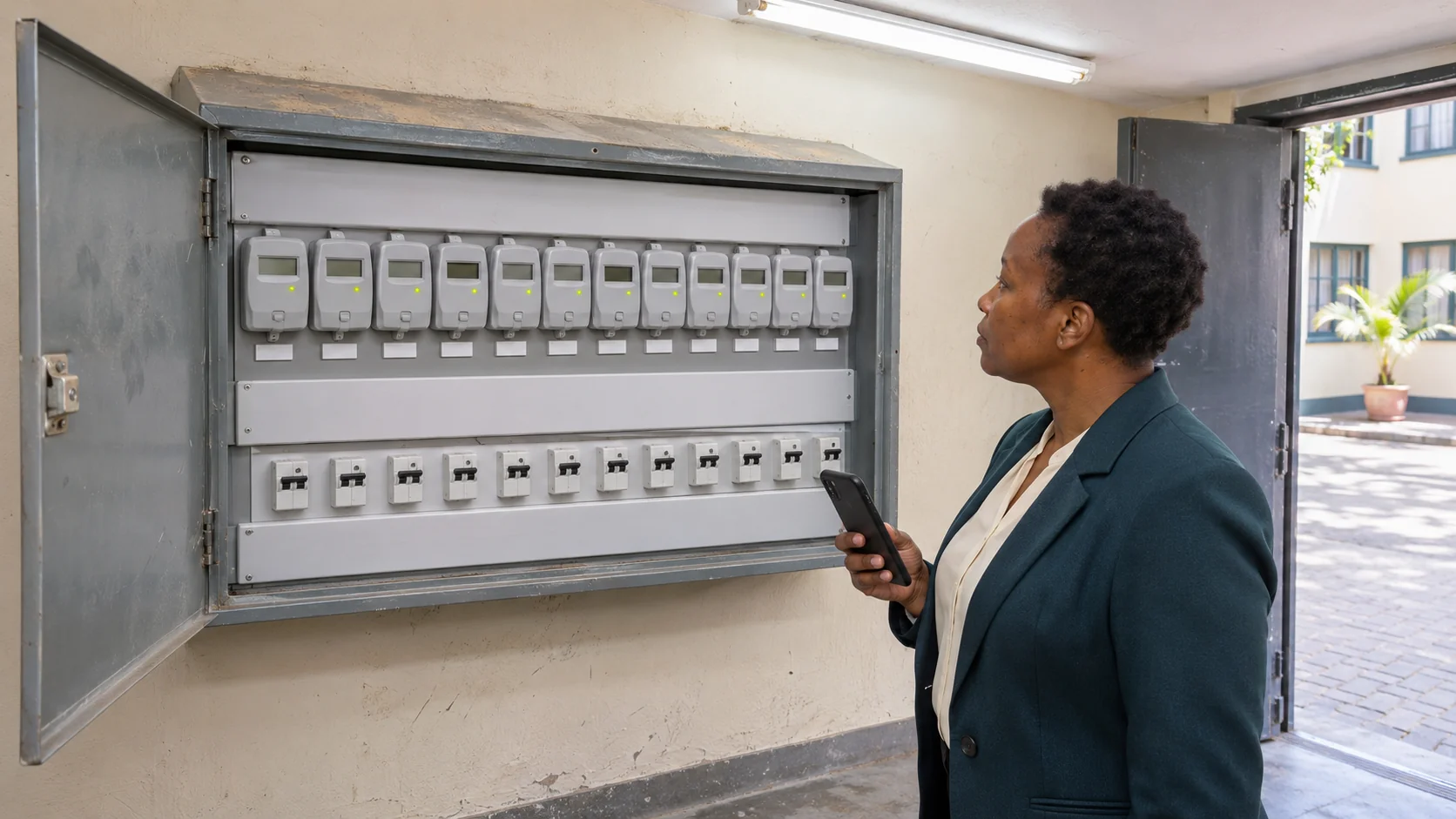
In November 2024, Lesaka Technologies agreed to pay R507 million for a company most South Africans have never heard of. Recharger sells prepaid electricity sub-meters to landlords and the tokens their tenants use to keep the lights on. At the time of the deal it had more than 460,000 registered meters in backyard rooms, flats, townhouse complexes, student residences and holiday homes across the country (Lesaka).
Lesaka is a payments group. It runs Kazang's vending devices, the Connect and Adumo card-acceptance businesses and the EasyPay bill payment network, and it does not make its money from hardware. What it bought was a recurring flow of small, predictable payments: every month, hundreds of thousands of tenants buy electricity for a meter that only accepts one company's tokens, and every purchase passes through a platform Lesaka now owns.
This case study explains how prepaid sub-metering works, why landlords use it, why a listed payments group valued it at about six times earnings before interest, tax, depreciation and amortisation, what the law says about charging tenants for electricity, and what property owners and managers can learn from the deal.
The numbers at a glance
| Figure | Period | Source |
|---|---|---|
| Purchase price for Recharger: R507 million, paid in two tranches of cash and shares | Agreed November 2024 | Lesaka |
| Expected valuation: about 6 times EV/EBITDA | At announcement | Lesaka |
| Registered prepaid electricity meters: more than 460,000 | At announcement | Lesaka |
| Completion of the acquisition | 3 March 2025 | Lesaka announcement |
| Recharger service fee: R29 excluding VAT per sub-meter, in months when tokens are bought | Current terms | Recharger |
| Lesaka Enterprise division: prepaid solutions throughput up more than 50% to R2.8 billion; bill payments up 12.5% to R9 billion | Reported with third-quarter FY2026 results | Nasdaq summary of Lesaka's call |
How prepaid sub-metering works
A building or property with several units usually has one connection to the municipality or Eskom, measured by one main meter. The landlord receives the bill for everything that passes through it. Before sub-metering, a landlord had two choices: include electricity in the rent and absorb the risk of heavy use, or split the bill between tenants by some estimate and argue about it every month.
A prepaid sub-meter solves that. An electrician installs a separate meter for each unit, between the main supply and the unit's wiring. Each sub-meter works like a municipal prepaid meter: it holds a balance of units, deducts them as the tenant uses electricity and cuts the supply when the balance reaches zero. The tenant buys a token, types it into the meter's keypad, and the units are added.
The difference from a municipal meter is where the money goes. When a tenant buys a token for a sub-meter, the payment goes to the sub-metering company, which takes its fee and passes the rest to the landlord. The landlord uses that money to pay the main electricity bill. In Recharger's description, the amount purchased is reimbursed to the landlord's nominated bank account to help pay the municipality or Eskom (Recharger).
The tokens use the same Standard Transfer Specification as most municipal prepaid meters in South Africa, so the 20-digit token, the keypad and the occasional key change token will look familiar to anyone who has used a prepaid meter. What is different is that each sub-meter is registered to a particular vending company, and only that company, or the channels it works with, can issue tokens for it.
Why landlords use it
For a landlord, prepaid sub-metering removes the biggest source of conflict in a shared electricity supply. Each tenant pays for exactly what they use, before they use it. There are no arrears to chase, no estimates to dispute and no surprise when a tenant leaves after a winter of heaters and a large bill.
It suits the kinds of property where bills are hardest to split. Backyard rooms behind a family home, flats in an older building, townhouse complexes with a single bulk supply, student residences, holiday rentals with short stays and staff accommodation on farms and mines all share one connection among several households. In each case the landlord wants tenants to manage their own use and pay in advance.
It also suits tenants who want control. A prepaid meter shows how much electricity is left, and tenants can buy small amounts when money is tight. Recharger's materials describe the benefit to landlords as being able to charge tenants the exact amount they use each month without measuring or splitting bills (Recharger). Rising tariffs have made that more important: when electricity costs go up every July, a fixed allowance in the rent quickly becomes a loss for the landlord.
How Recharger's model works
Recharger describes itself as a leading supplier of prepaid electricity sub-meters, tokens and token vending solutions. Its public pages set out a simple model.
Registration is free. Landlords buy sub-meters, have them installed by a registered electrician and register them under one online profile, from which they can see usage and purchases. A monthly service fee of R29 excluding VAT per sub-meter is deducted from the landlord's rebate in the months when tokens are bought for that meter (Recharger).
Tenants buy tokens through several channels: Recharger's own payment portal, PayCity, mobile vendors using Flash and Kazang devices, and banking apps (Recharger). The breadth of channels matters. A tenant who can buy a token at the spaza shop, in a banking app or online is less likely to sit in the dark because the one place they know is closed.
The payment then flows back to the landlord as a reimbursement, net of fees, which the landlord uses to pay the bulk electricity bill. The sub-metering company sits in the middle of every transaction, which is the position Lesaka paid for.
Why Lesaka paid R507 million
Lesaka announced the deal on 19 November 2024 and completed it on 3 March 2025. The price was R507 million, paid in two tranches made up of cash and Lesaka shares, and Lesaka said it expected to conclude the deal at about six times EV/EBITDA (Lesaka; BusinessDay). Divided by the 460,000 registered meters, the price works out to roughly R1,100 a meter, by our arithmetic. Registered meters are not all active, so the price per active meter is higher.
Several features of the business explain why a payments group would pay that.
It is an annuity
Electricity is bought every month by almost every tenant, whatever the economy is doing. A tenant who moves out is replaced by another tenant, and the meter stays on the wall. Each meter that is used produces a monthly service fee and a stream of token purchases. That makes revenue far more predictable than many payments businesses, where volumes swing with consumer confidence.
It is hard to switch
A sub-meter is registered to its vending company. A landlord who wants to change provider usually has to change or re-register meters, which takes an electrician and effort. That makes the customer base sticky.
It fits Lesaka's other businesses
Tenants already buy Recharger tokens through Kazang devices, and Lesaka runs one of the largest bill payment networks in the country through EasyPay. Owning the sub-metering platform means Lesaka earns on both the meter and the channel. In its third-quarter FY2026 results, Lesaka reported that prepaid solutions throughput in its Enterprise division rose more than 50% to R2.8 billion and bill payments rose 12.5% to R9 billion, with Enterprise including three months of Recharger's contribution (Nasdaq).
It opens a door to credit
On the same results call, Lesaka said it planned to launch an electricity advance product that would let utility customers load electricity when they are short of funds (Lesaka Q3 FY2026 transcript). A company that sees every purchase on hundreds of thousands of meters knows when households run low, and can offer a small advance at the moment it is needed. Our case study on the airtime advance economy looks at how the same idea has grown in airtime.
It came at the right time for Lesaka
Lesaka's merchant division was under pressure from falling airtime margins, and the group was moving towards businesses with steadier economics. In the year to June 2026, Lesaka returned to profit at group level while its merchant division reset (EWN). Prepaid electricity for tenants is one of the steadier businesses it now owns.
What the law says about charging tenants for electricity
Prepaid sub-metering is legal and common, but charging tenants for electricity is regulated, and landlords who overcharge have lost cases. The rules come from several sources: the Electricity Regulation Act and NERSA, municipal electricity by-laws, rental housing law and consumer protection law. They differ between municipalities, so this section describes the principles and not the rule in any particular area. Get advice for your own property.
Resale is largely outside licensing, but not outside the rules
Eskom's guidelines on electricity resale note that resale has been largely unregulated, because businesses that resell electricity are generally not licensed or registered with a regulator (Eskom). NERSA called for resellers to be regulated as long ago as 2014 (Engineering News). In practice, municipalities and tribunals have filled much of the gap.
Municipal by-laws require approved sub-meters
Many municipal electricity by-laws require electricity resold to an end user to be measured through a sub-meter approved by the municipality or meeting a national standard, and some set out how resellers may charge. Polokwane's 2020 electricity supply by-law is one example of a municipality setting such rules (City of Polokwane). Check your municipality's by-law before installing or changing sub-meters.
Profit on electricity is risky
A frequently cited case is a ruling by Gauteng's Rental Housing Tribunal, reported in 2013, against a Johannesburg landlord who charged tenants more than the cost of electricity. The tribunal found that a landlord without a licence to sell electricity could not make a profit on it, and that administrative costs should be built into the rent instead (IOL). More recently, the City of Ekurhuleni urged electricity resellers not to charge above approved tariffs (The Citizen).
The safe principle is that tenants should pay what the electricity costs the landlord, at the tariff that applies to the property, with any vending service fee disclosed. A landlord who wants to recover administration costs should do it through the rent, openly.
Tariffs change every year
Municipal tariffs usually change on 1 July and Eskom's on 1 April. A sub-meter must be configured with the right tariff, and the configuration must be updated when tariffs change. Bodies corporate in Ekurhuleni found out how costly tariff errors can be when a tariff discrepancy led to overcharging (The Citizen). Ask your sub-metering provider how tariffs are set on your meters and who updates them.
Tenants have places to complain
Tenants who believe they are overcharged can approach the Rental Housing Tribunal in their province, and sometimes the municipality. Clear records of tariffs, fees and purchases protect a landlord who is charging correctly.
The tenant's side of the meter
For a tenant, a prepaid sub-meter works like any prepaid meter, with a few differences worth knowing.
The token must come from the meter's vending company or a channel it works with. A tenant who tries to buy for a sub-meter through a channel that does not support it will be told the meter is not found or not supported. The meter number, the vending company's name and the list of purchase channels should be given to every tenant when they move in.
The price per unit depends on the tariff configured on the meter and on any fees. Tenants who notice that the same amount buys fewer units than before should ask the landlord for the tariff and fee breakdown. Our guide to why you get fewer prepaid units explains the common reasons, including inclining block tariffs, which make each extra unit dearer as monthly use rises.
Key change tokens sometimes arrive with a purchase when the meter's encryption keys need to change, and they must be entered before the purchase token. Our guide to key change tokens explains the order.
Free Basic Electricity is a municipal or Eskom benefit linked to an eligible household and its registered supply. A tenant on a private sub-meter may not be able to receive it directly, and should ask the landlord or metering company how, or whether, support reaches the household. Our guide to Free Basic Electricity explains eligibility.
A landlord's numbers: a worked example
The example below uses stated assumptions to show how the money moves. It does not describe any real property, provider or tariff.
Assume a landlord owns a property with eight rented units on one municipal connection. Each unit uses an average of 300 kWh a month. Assume the municipal tariff that applies to the property works out at R3.50 per kWh including VAT, averaged across the month. The property's total use is 2,400 kWh, and the municipal bill for that electricity is R8,400 a month.
Without sub-meters, the landlord must either include electricity in the rent or split the bill. If one tenant runs a heater all winter and another is away for a month, an equal split is unfair to both, and a landlord who includes electricity in the rent carries the risk of every tenant's habits. When a tenant leaves owing for electricity, the landlord absorbs the loss.
With prepaid sub-meters configured at the same tariff, each tenant buys what they use. If the eight tenants together buy R8,400 of tokens in a month, the landlord receives that amount less the sub-metering provider's fees and uses it to pay the municipal bill. At a service fee of R29 excluding VAT per meter per month, eight meters cost R232 excluding VAT in a month when every meter is used, or about R2,800 a year. The landlord pays for the meters and installation upfront, and gains a supply where every unit pays in advance.
The gap between what tenants buy and what the municipality bills is where landlords lose money. Common areas such as outside lights, gate motors and pumps use electricity no tenant pays for. Vacant units may use a little. Sub-meters and wiring have small losses. A landlord who checks each month how tenant purchases compare with the municipal bill can see that gap and plan for it, usually through the rent, openly.
Setting up sub-metering properly
- Read your municipality's electricity by-law, or ask the municipality, about resale and approved sub-meters.
- Choose a sub-metering provider using the questions below, and confirm that its meters meet your municipality's requirements.
- Have a registered electrician install the meters and issue the required certificate of compliance.
- Configure each meter with the tariff that applies to the property, and keep a record of the configuration.
- Give every tenant a written pack: the meter number, the vending company, where to buy tokens, the tariff and any fees, and what to do if a token fails or key change tokens arrive.
- Put the electricity arrangement in the lease, including how tariff changes will be communicated.
- Each month, compare tenant purchases with the municipal or Eskom bill and investigate unusual differences.
- Each year, update the tariff on every meter when the municipal or Eskom tariff changes, and tell tenants before it takes effect.
Landlords who follow these steps rarely end up in front of a tribunal, because tenants can see what they are paying and why.
The wider sub-metering market
Recharger is one of several companies serving landlords. Others, such as Citiq Prepaid and Ideal Prepaid, offer sub-meters, vending and management portals, and some property management software includes electricity billing. Municipalities also offer prepaid metering directly, where each unit has its own municipal connection. And smart meters that report usage remotely are increasingly used in larger developments.
For landlords, the choice comes down to the costs per meter, the purchase channels available to tenants, how tariffs are configured, the quality of support and how easily the landlord could move to another provider later. Lesaka's purchase of Recharger suggests that consolidation in this market has started, as it has in airtime vending and card acceptance.
What the deal teaches
Recurring necessities are worth more than one-off sales
Lesaka paid for a stream of monthly purchases, not for meters. Any business that controls access to a monthly necessity, whether electricity, water, data or transport, holds something a payments group values.
Control of the channel matters
Recharger's tokens are sold through many channels, but every one of them depends on Recharger's platform. The company in the middle of every transaction earns on every transaction.
Switching costs protect a business
Because changing sub-meter provider takes effort, Recharger's customers stay. That stickiness is part of why the business could be valued at about six times EBITDA.
Data leads to credit
Lesaka's planned electricity advance follows the same path as airtime advances: a company that sees regular purchases can predict who will run short and when.
Regulation shapes the margin
Because landlords generally may not profit on electricity, the economics depend on transparent fees. A sub-metering business that helps landlords stay within the rules protects itself as well as its customers.
What this means for property owners and managers
The deal is a reminder that electricity in rental property is a business in its own right, and that landlords and managers have choices about how to run it.
Property managers with portfolios of flats or complexes can review how each building's electricity is metered and paid for, and whether tenants have convenient ways to buy. Bodies corporate can check that sub-meters are approved, that tariffs are updated each year and that residents can see the tariff and fees. Student housing operators can decide whether electricity should be prepaid by students or included in the rent. Employers that house staff, on farms, mines, game lodges or construction sites, can decide whether to buy electricity for staff housing centrally. Holiday rental owners can use prepaid sub-meters to stop guests running up large bills.
In each case the questions are the same: who pays, how much, through which channels, and how the landlord stays within the law.
Build it: electricity purchases in your property platform
A property management company or a residents' app can let tenants or staff buy electricity without leaving it, provided the meters are supported by the supplier behind the app.
SIMcloud's electricity API accepts a meter number for a meter check before any money moves, returning whether the meter is supported. Purchases carry your own reference, so each token can be tied to a unit and a tenant, and status can be queried by that reference. The fee is the purchase amount multiplied by 3 and divided by 103, rounded down to a whole rand and never more than R10. Tax invoices are generated monthly, with a report of every purchase.
Support varies by meter and vending arrangement, especially for private sub-meters, so check each meter before planning a rollout. Our public meter check lets you test a meter number, and our guide to checking whether a meter is supported explains the results. If you need a portal built around your portfolio, we take on custom work.
Give it: electricity for staff housing and managed units
Employers and property managers who pay for electricity themselves, for staff accommodation, vacant units being prepared for new tenants or serviced apartments where electricity is included, can buy for many meters at once and on a schedule.
SIMcloud supports buying electricity for many meters from one CSV file, with a reference for each meter, and recurring monthly electricity purchases, with balance warnings three days and one day before a scheduled purchase if the wallet is too low. Our guide for property managers covers portfolio set-up, approvals and reconciliation.
Questions to ask a sub-metering provider
- What does each meter cost to buy and install, and who may install it?
- What monthly or per-purchase fees apply, and are they deducted from the landlord's reimbursement or charged to tenants?
- Through which channels can tenants buy tokens, and are any open after hours?
- How is the tariff on each meter set, and who updates it when municipal or Eskom tariffs change?
- How quickly, and how often, is money reimbursed to the landlord?
- What happens when a token fails, a meter is faulty or a key change is needed?
- Can the landlord see each meter's purchases and units online, and export them?
- If the landlord moves to another provider, what happens to the meters?
- Are the meters approved under the municipality's by-laws?
Timeline
- 2013: A Gauteng Rental Housing Tribunal ruling, as reported, finds a landlord without a licence could not profit from electricity charged to tenants.
- July 2014: NERSA calls for electricity resellers to be regulated.
- July 2024: The City of Ekurhuleni urges electricity resellers not to exceed approved tariffs.
- 19 November 2024: Lesaka announces its agreement to buy Recharger for R507 million.
- 3 March 2025: Lesaka completes the acquisition.
- May 2026: Lesaka reports strong growth in Enterprise prepaid and bill payments and plans an electricity advance product.
- September 2026: Lesaka reports a group profit for the year to June 2026.
Frequently asked questions
What is a prepaid sub-meter?
A separate prepaid meter installed for one unit on a property that shares a single electricity connection. The tenant buys tokens for it, and the money goes to the landlord, net of fees, to pay the main bill.
Who owns Recharger?
Lesaka Technologies bought Recharger for R507 million, completing the deal on 3 March 2025.
Can a landlord make a profit on electricity?
Generally, landlords without a licence should not profit on electricity charged to tenants. Tribunals and municipalities have acted against overcharging. Charge at cost, disclose fees and get advice on your municipality's rules.
Why can I only buy tokens for my sub-meter in certain places?
Each sub-meter is registered with a vending company, and only that company or channels it works with can issue tokens for it. Ask your landlord for the list of channels.
Can I get Free Basic Electricity on a sub-meter?
Free Basic Electricity is linked to eligible households and their registered supply. On a private sub-meter it may not reach you directly. Ask your landlord or the metering company.
Can SIMcloud sell tokens for every sub-meter?
No supplier can assume that. Check each meter with a meter check before buying or planning a rollout.
How do I pay for electricity for staff housing?
Buy centrally for the meters you are responsible for, one at a time, from a CSV file or on a recurring schedule, and keep a reference for each meter so finance can reconcile.
Sources
- Lesaka: to acquire Recharger (19 November 2024)
- Lesaka: Lesaka buys prepaid electricity vendor for R507m
- BusinessDay: Lesaka buys prepaid electricity metering business (20 November 2024)
- Lesaka: completes the acquisition of Recharger
- Recharger: frequently asked questions
- Recharger: tenant information
- Nasdaq: Lesaka Q3 earnings call highlights
- Lesaka: Q3 FY2026 results call transcript
- EWN: Lesaka returns to profit (14 September 2026)
- Eskom: Guidelines on electricity resale
- Engineering News: Regulate electricity resellers, NERSA (22 July 2014)
- City of Polokwane: Electricity Supply By-law 2020
- IOL: Tenants warned to be on their guard
- The Citizen: Electricity resellers urged not to exceed approved tariffs (17 July 2024)
- The Citizen: Ekurhuleni body corporates and the tariff mess
Figures are as published by the companies or reported by the outlets linked above, for the periods stated. This article is general information, not legal advice. SIMcloud is not affiliated with Lesaka, Recharger or any other company named. Product names are used only to identify them.