
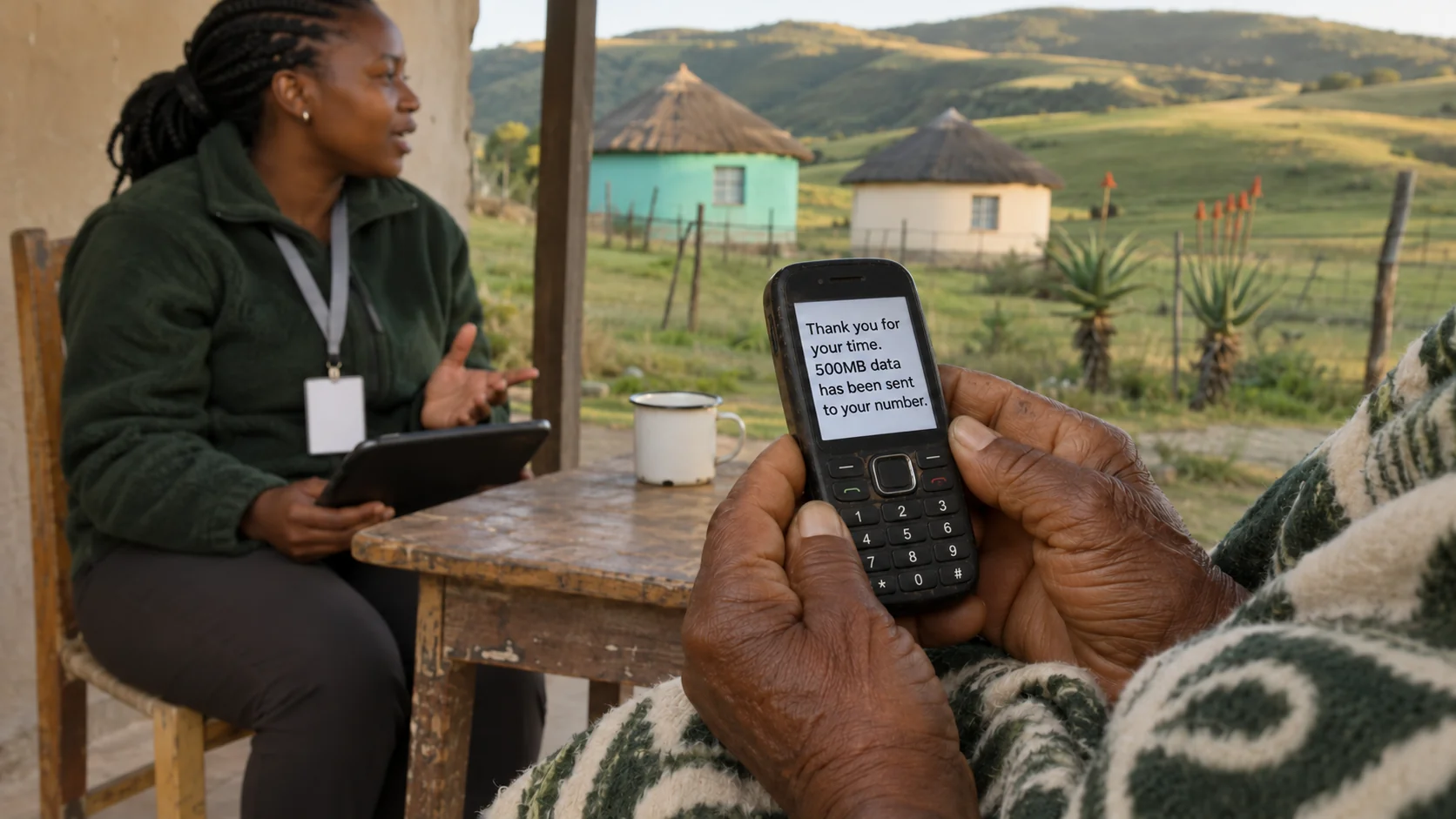
On 20 April 2020, every student at the University of the Witwatersrand started receiving 30GB of mobile data a month. The country was in its first Covid-19 lockdown, campuses were closed and teaching had moved online in a matter of weeks. Wits had negotiated with all four mobile networks so that each student, whatever network they used, received 10GB of anytime data and 20GB of night-time data at no cost to them (Wits).
Universities across South Africa did the same within days of each other. It was one of the largest exercises in paying people in data the country has seen, and it was improvised under pressure. The universities' own notices from that period, together with a body of research from across Africa on paying survey respondents in airtime, show what works when an organisation gives connectivity at scale, and what goes wrong.
This case study draws those lessons together for anyone who pays people in data or airtime today: training providers funding learners, employers supporting field staff, researchers paying respondents, NGOs supporting community workers and companies rewarding customers.
The numbers at a glance
| Figure | Period | Source |
|---|---|---|
| Wits: 30GB a month per student (10GB anytime, 20GB night) on all four networks, at no cost to students | From 20 April 2020 | Wits |
| University of Pretoria: 20GB per student (10GB anytime, 10GB night) | May 2020 | University of Pretoria |
| Competition Commission: Vodacom and MTN can cut data prices by 30% to 50% | December 2019 | Daily Maverick |
| Vodacom settlement: 30-day 1GB bundle cut from R149 to no more than R99 | Effective 1 April 2020 | Competition Commission |
| Uganda trial: promised airtime incentive raised phone-survey cooperation to 59.9% (risk ratio 1.47 against no incentive) | Published 2022 | JMIR |
| Ghana and Tanzania: airtime transfers raised survey completion by about 6 to 8 percentage points | 2015 fieldwork | Center for Global Development |
What the universities did in 2020
When the lockdown began, universities faced the same problem at once. Many students lived in homes without fixed internet, depended on prepaid mobile data and could not afford the volumes needed for online classes. Each university negotiated with the networks, in some cases jointly through the Department of Higher Education and Training, and announced its arrangement to students.
| University | Data provided | Notes | Source |
|---|---|---|---|
| Wits | 30GB a month: 10GB anytime and 20GB night | All four networks, at no cost to students; later changed to a need-based model | Wits |
| UCT | Mostly 30GB: 10GB anytime and 20GB night; Telkom 40GB split evenly | Negotiated separately with each network | UCT |
| University of Pretoria | 20GB: 10GB anytime and 10GB night | Negotiated with all four networks | UP |
| Rhodes | 10GB anytime and 20GB night a month | Vodacom, MTN and Cell C agreed first; Telkom talks continued | Rhodes |
| Stellenbosch | 10GB daytime and 20GB night | Some student groups excluded | Stellenbosch |
| University of the Free State | Three-month bundle | A national agreement linked to DHET grant conditions covered Vodacom, MTN and Cell C; Telkom users were handled differently | UFS |
What the universities' notices reveal
The universities' public notices show several problems that anyone paying in data will recognise.
Every network had to be handled separately
UCT's notice said its agreements were negotiated separately with each provider. Rhodes announced three networks while talks with Telkom continued. The Free State's notice said the national agreement could not be reached for Telkom subscribers and suggested students could move to another network to get the bundle. A student's network is not the organisation's choice, and an arrangement that covers three networks leaves out everyone on the fourth.
Much of the data was night data
Most bundles gave twice as much night data as anytime data. Night data is cheaper for networks to provide because their networks are quieter, which made larger totals affordable. For students attending classes during the day, the anytime portion was what counted, and the headline 30GB overstated what was useful for daytime learning.
Blanket provision gave way to need
By June 2020, Wits had moved to a model in which only students who said they needed data kept receiving it, and the data worked for selected teaching and learning sites through a secure gateway on the university's network (Wits). Giving everyone the same large bundle was fast; targeting it was cheaper and more effective once the emergency settled.
Data without devices is not enough
Data was only half the problem. Wits announced that laptops were being delivered to students who needed them (Wits), and other universities ran similar programmes. A data bundle on a basic phone does not make it possible to write an essay or join a video lecture.
Zero-rated is not always zero-cost
Universities also had their learning sites zero-rated, so students could use them without spending data. Stellenbosch's guidance noted that Vodacom required a minimum data balance for students to reach its zero-rated learning platform, so students were advised to keep some data even though the site was zero-rated (Stellenbosch). Small technical rules like this decide whether a well-meant arrangement works for the person holding the phone.
Some arrangements have lasted
Unisa, a distance-learning university, has continued to provide access to its zero-rated sites through reverse billing, and data for exam periods, through September 2026 (Unisa). For a university whose students learn online by design, connectivity has become a permanent cost of teaching.
The policy background: prices and zero-rating
The universities' arrangements came months after a major ruling on data prices. In December 2019 the Competition Commission's Data Services Market Inquiry found that Vodacom and MTN could reduce prices by 30% to 50%, and recommended cheaper small bundles, free daily data for prepaid customers and zero-rating of public-benefit content (Daily Maverick). In March 2020, Vodacom agreed to cut its 30-day 1GB bundle from R149 to no more than R99 from 1 April 2020, with bigger proportional cuts for the smallest bundles, and to consolidate its zero-rated services on a platform called ConnectU (Competition Commission).
Zero-rating has since become a formal regime. ICASA now administers zero-rating under General Notice 2450 of 2024, and the Government Communication and Information System sets rules for government websites: sites must be hosted locally, embedded content and links to other sites are not zero-rated, and video must not exceed 480p (GCIS). The Department of Basic Education publishes guidance on zero-rated education sites (DBE).
Bundle prices still fall steeply with size. ICASA's March 2026 tariff analysis noted, for example, that Telkom introduced a 1.2GB bundle at R79 and a 12GB bundle at R499 (ICASA). By our arithmetic, that is about R66 a gigabyte for the small bundle and about R42 for the large one. Organisations that buy data for people can use that slope in their favour: one larger bundle often costs much less per gigabyte than several small top-ups.
What research says about paying people in airtime
Researchers who run phone surveys in Africa have tested airtime incentives in randomised trials, and the results are useful for anyone who pays people to respond, participate or complete a task.
A pair of trials in Uganda and Bangladesh, published in 2022, tested interactive voice response surveys with no incentive, a promised airtime incentive or a lottery for airtime. In Uganda, cooperation with the promised incentive reached 59.9%, with a risk ratio of 1.47 against no incentive; in Bangladesh it reached 39.3%, with a risk ratio of 1.38. Response rates were also higher in the incentive groups (JMIR). A follow-up trial compared a single and a double airtime amount and found no significant difference between them (Johns Hopkins).
A Center for Global Development study of surveys in Ghana and Tanzania found that airtime transfers improved completion rates by about 6 to 8 percentage points, but that the cost per completed response was not always lower than without incentives (CGD). The authors of the Uganda trial noted that earlier studies of airtime incentives in low- and middle-income countries had produced inconclusive results.
Three lessons stand out. Offering airtime makes people more willing to take part. Doubling the amount may not add much, so a modest, reliable incentive can do the job. And the incentive has to be judged on its cost per useful response as well as on how much it raises participation. Our guide to airtime incentives for surveys applies these points to South African research.
Employers, learners and field staff
The same questions arise in workplaces every month. Training providers fund data so that learners can attend online sessions and submit work. Employers fund airtime for staff who call customers, coordinate shifts or report from the field. NGOs fund data for community health workers who use mobile apps. In each case the organisation needs the person to be connected at particular times, and the person may not be able to afford it.
The way connectivity is provided affects tax and administration. SARS treats cash cellphone allowances as taxable income, while the private use of phone services that an employer provides mainly for business can be treated differently under the fringe benefit rules (SARS). Check the current rules with a payroll adviser before choosing an approach. Our guide to cellphone allowances sets out the common options, and our guide to data bundles for learnerships covers the training sector.
How to pay people in data well
The universities' experience and the research point to a set of practical principles.
Know each person's network
Data bundles are network-specific. A bundle meant for an MTN number cannot be loaded onto a Vodacom number. Because numbers can be ported, the prefix is not reliable. Check each number with a network lookup before the first send, and again when a send fails. Our analysis of which network a South African number is on shows why.
Cover every network
An arrangement that leaves out one network leaves out everyone on it, as the Telkom gaps in 2020 showed. Use a supplier that sells on all four major networks.
Match the bundle to the task
Night data does not help someone who studies or works during the day. Social bundles that only work in particular apps will not open a learning platform. Choose anytime data for anything time-sensitive, and check what each bundle covers.
Size it for the work
Estimate how much data the task needs. Video calls use far more than messaging, and a learner who joins several video sessions a week needs a different bundle from a field worker who sends a few reports. Our data usage calculator gives rough estimates by activity.
Time it for when it is needed
Data delivered the day before a session is more useful than data delivered at the start of the month and spent by the third week. Weekly delivery smooths the gaps.
Target it once the urgency passes
Wits moved from data for everyone to data for those who asked. A simple request process, with sensible limits, puts data where it is needed and cuts waste.
Keep the incentive modest and reliable
The research suggests that a reliable, modest amount works about as well as a larger one. Deliver it promptly, because a promised reward that arrives late damages trust.
Confirm delivery and handle failures
Some sends will fail: a number is wrong, a network rejects the bundle or the supplier has a problem. Check every order's status, reverse or resend failed orders with the correct details, and tell the person what happened. Never resend an order whose outcome is unknown until you have checked it, or you may pay twice. Our guide to adding a backup route explains how.
Reconcile and keep records
Each send should carry a reference that ties it to a person, a period and a reason. Finance needs that to match costs to budgets, and auditors may ask for it.
Protect personal information
Phone numbers are personal information under POPIA. Collect them for a stated purpose, store them securely, share them only with suppliers under a written agreement, and delete them when they are no longer needed.
Airtime or data?
Organisations often have to choose whether to give airtime, which is a rand balance, or data, which is a bundle. Each suits different purposes.
Airtime is flexible. The person can use it for calls, SMS or data, or convert it into a bundle of their choice through their network's menu. That flexibility is useful for field staff who mainly make calls, and for incentives where the organisation does not mind how the value is used. The drawback is that airtime used directly for data, without buying a bundle, is charged at out-of-bundle rates, which are much higher per megabyte. A person who receives R50 of airtime for an online class and does not convert it into a bundle may find it gone after a short session.
Data is targeted. A bundle sent for learning or reporting is used as data, at bundle rates, and the organisation knows how much connectivity it has provided. The drawback is that bundles are network-specific and come in fixed sizes, so the organisation must know each person's network and choose a bundle that exists on it.
Vouchers are a third option for incentives where connectivity is not the point. A grocery or retail voucher can be a better reward for completing a long survey, for example, and does not depend on the person's network. SIMcloud sells digital vouchers at face value alongside airtime and data.
A sensible rule is to give data when the purpose is connectivity for a task, airtime when the purpose is calls or flexibility, and vouchers when the purpose is a reward.
Running a request-based model
Wits's move from data for everyone to data for those who asked is a model any organisation can use once the first rush is over. Instead of sending the same bundle to everyone every month, the organisation lets people request connectivity when they need it, within limits it sets.
A request model needs a few rules. Decide who may request, how much and how often. Decide whether requests are approved automatically within limits or by a person. Record each request and the reason, so that budgets and patterns can be reviewed. And check for abuse: repeated requests from the same number, numbers shared between people or requests that do not match attendance or activity.
SIMcloud supports this with recharge request links. Each contact can be given a link that offers only the airtime amounts and data bundles you allow, and every resulting order is recorded against that contact with your reference.
Common mistakes when paying in data
- Sending everything on the first of the month, so people run out before the end.
- Choosing the network from the number's prefix instead of checking it.
- Counting night or app-only data as if it were anytime data.
- Using an old list of numbers without confirming them, so bundles go to numbers people no longer use.
- Promising a reward without a delivery date, then sending it weeks later.
- Resending a whole batch after a partial failure, and paying twice for the successful half.
- Collecting phone numbers without saying how they will be used, or keeping them after the programme ends.
- Giving data without checking that people have a device that can use it for the task.
A worked example: a training provider
The example below uses stated assumptions. It does not describe any real organisation or price.
Assume a training provider runs a learnership for 400 learners who attend two online sessions a week and submit work through a learning platform. Assume each learner needs about 2GB of anytime data a month for this. The provider decides to send a 1GB anytime bundle every two weeks instead of 2GB on the first of the month, so that learners do not run out before the second half of the month.
Before the first send, the provider checks every learner's network with a lookup and finds that some numbers are not on the network their prefix suggests. It uploads a CSV with each learner's number, the right bundle for their network and a reference made of the learner ID and the period. A few sends fail because numbers have changed. The provider contacts those learners, updates the numbers and resends with the same references. At month-end, finance matches every bundle to a learner and a cost centre using the references, the transaction report and the monthly tax invoice.
The result is predictable: learners have data when sessions happen, the provider pays only for bundles that were delivered, and every rand can be accounted for.
Give it: data and airtime at scale with SIMcloud
SIMcloud lets organisations send data and airtime to many people at once, on every major network.
Upload a CSV of numbers, bundles or amounts and references, and SIMcloud validates the file before anything is sent. Our bulk recharge CSV guide shows the format. Contacts are checked with a network lookup in the background, so data bundles match each person's network. Recurring orders send the same airtime or data every 7 or 30 days between a start and end date, and scheduled orders send once at a set time. There is no fee on airtime or data, no monthly fee, and tax invoices are generated monthly with a report of every transaction. Failed recharges are reversed to your wallet.
Our guides to sending bulk data and sending bulk airtime cover the steps.
Build it: automatic incentives from your own platform
A survey platform, learning management system or field app can send an incentive automatically when a person completes a task. When a survey is submitted or a module is passed, your system calls SIMcloud's airtime or data API with the person's number and a reference for the task, and checks the order's status to confirm delivery. Our guide to building a data bundle platform covers catalogue handling, network checks and duplicate protection.
Timeline
- December 2019: The Competition Commission finds that Vodacom and MTN can cut data prices by 30% to 50%.
- March 2020: Vodacom agrees to cut its 30-day 1GB bundle from R149 to no more than R99 from 1 April.
- 20 April 2020: Wits begins giving every student 30GB a month on all four networks.
- April to June 2020: UCT, UP, Rhodes, Stellenbosch, UFS and others announce data arrangements.
- June 2020: Wits moves to need-based data through a secure gateway.
- 2022: Trials in Uganda and Bangladesh show airtime incentives raise phone-survey cooperation.
- May 2024: ICASA's zero-rating notice is published.
- March 2026: ICASA's tariff analysis shows larger bundles costing much less per gigabyte.
- October 2025 to September 2026: Unisa continues zero-rated access and exam data for students.
Frequently asked questions
How much data did universities give students in 2020?
Arrangements varied. Wits gave 30GB a month (10GB anytime, 20GB night), UP gave 20GB (10GB anytime, 10GB night), and Rhodes and Stellenbosch gave 10GB anytime and 20GB night.
Is night data useful for students?
Only for work done at night. Daytime classes and submissions need anytime data, so check what share of a bundle is usable when people need it.
Do airtime incentives increase survey responses?
Trials in Uganda, Bangladesh, Ghana and Tanzania found that airtime incentives increased cooperation or completion. Doubling the amount did not significantly improve results in one trial.
What does zero-rated mean?
A zero-rated site can be used without using up your data bundle. Some networks still require a small data balance, so keep some data available.
Can I send data to people on different networks in one batch?
Yes. With SIMcloud you can upload a CSV with numbers on any of the major networks, with the right bundle for each, and the file is validated before anything is sent.
Is a cellphone allowance taxable?
SARS generally treats cash cellphone allowances as taxable income. Phone services provided by an employer mainly for business can be treated differently. Check with a payroll adviser.
How do I avoid paying twice when a send fails?
Check the status of every order before resending, resend only orders that definitely failed, and use the same reference so duplicates can be traced.
Sources
- Wits: Covid-19 update 24, data access on all four networks
- Wits: Covid-19 update 25
- Wits: Covid-19 update 33, secure gateway
- UCT: Pre-paid data for students (22 April 2020)
- University of Pretoria: Data for students
- Rhodes University: Mobile data bundles for students
- Stellenbosch University: Data bundles for students
- Stellenbosch University: Zero-rating FAQ
- University of the Free State: Three-month data bundle
- Unisa: Update on student data provision
- Daily Maverick: Vodacom and MTN ordered to reduce data prices (2 December 2019)
- Competition Commission: Settlement agreement with Vodacom (10 March 2020)
- GCIS: Zero-rating of .gov.za websites
- Department of Basic Education: Zero-rating information
- ICASA: Bi-annual tariff analysis report (March 2026)
- JMIR: Airtime incentives in IVR surveys in Bangladesh and Uganda (2022)
- Johns Hopkins: Does airtime incentive amount influence IVR survey participation?
- Center for Global Development: Incentives in mobile phone surveys
- SARS: Guide for employers in respect of fringe benefits
Figures are as published by the organisations or reported by the outlets linked above, for the periods stated. This article is general information, not tax advice. SIMcloud is not affiliated with any university, network or organisation named.