
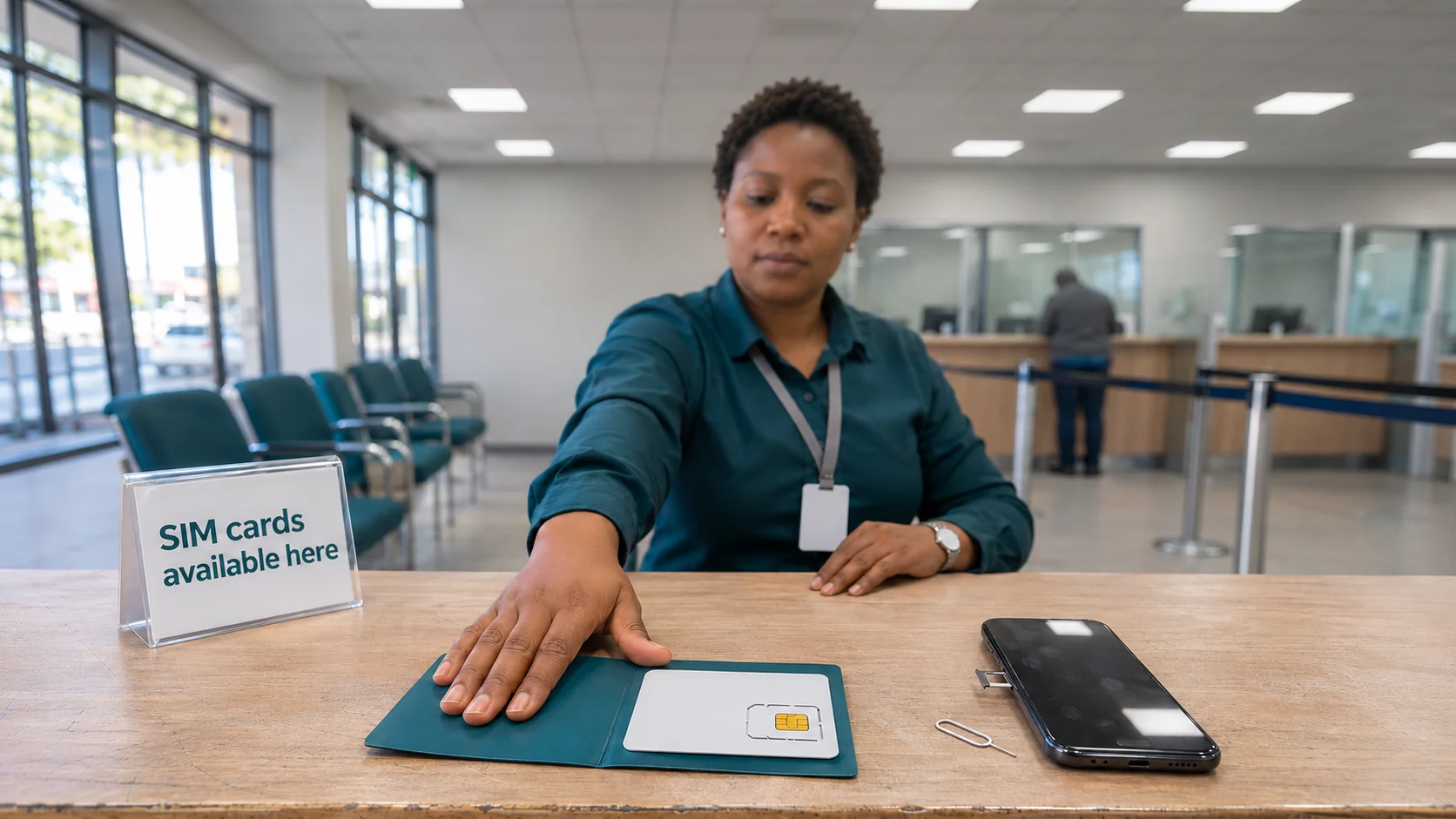
In late September 2022, Capitec started selling SIM cards. The bank already had more clients than any other in South Africa. Now it wanted to be their mobile network as well, on Cell C's infrastructure, with data that did not expire after 30 days and a price of R45 a gigabyte. Plenty of people in telecoms were sceptical. Banks had tried mobile before, and the results had been modest.
Four years later, Capitec Connect had 1.8 million clients who had used it in the previous three months. In the six months to August 2026 it earned R284 million in net income, up from R165 million a year earlier, and Capitec's value-added services, the airtime, data, electricity and vouchers sold inside its app, earned R3.5 billion over the same six months (Capitec interim results). A product that began as a convenience in a banking app had become one of the bank's most profitable lines.
Capitec is the most striking example, but the pattern runs across South African banking. FNB launched its own mobile network in 2015 and passed a million active subscribers in 2025. Standard Bank launched one in 2018. Absa has said it is assessing the model. Nedbank lends airtime through its app. Discovery Bank discounts it with Vitality rewards. Every large bank in the country now treats prepaid airtime and data as a strategic product, and the reasons say a great deal about how South Africans spend money and how any business with customers on their phones can earn their attention.
This case study follows the banks through four stages: selling prepaid in the app, running a mobile network, lending airtime, and moving into devices and home connectivity. It then sets out what other businesses can take from the story without a banking licence or a mobile network of their own.
The numbers at a glance
| Figure | Period | Source |
|---|---|---|
| Capitec Connect: 1.8 million clients active in the past three months, up from 1.1 million | Six months to 31 August 2026 | Capitec |
| Capitec Connect net income: R284 million, up from R165 million | Six months to 31 August 2026 | Capitec |
| Capitec value-added services net income: R3.5 billion, up from R2.7 billion | Six months to 31 August 2026 | Capitec |
| Capitec value-added services and Capitec Connect combined: R6.1 billion, up 38% | Year to February 2026 | Capitec |
| Capitec Connect net income: R193 million, up from R35 million | Year to February 2025 | BusinessDay |
| FNB Connect: 1 million active subscribers | November 2025 | ITWeb |
| Transactions through FNB Connect, including devices, solar and airtime: R28.6 billion, up about 18% | FirstRand's 2026 financial year | BusinessDay |
| Standard Bank's mobile service: more than 300,000 customers, now on MTN's network | September 2026 | BusinessDay |
| Banking apps: preferred channel for 61% of airtime and data purchases | Cited October 2026 | TechCentral, citing Shoprite |
Why airtime matters so much to a bank
A bank's biggest problem with most of its clients is that they do not need it very often. Salaries arrive once a month. Debit orders run without anyone looking at them. A loan is taken out once every few years. In between, the client has no reason to open the app, and an app that is not opened is an app that loses to a competitor when the client next needs something.
Airtime and data change that. South Africans buy them constantly, in small amounts, and most of them buy prepaid. ICASA's 2026 State of the ICT Sector report found that prepaid data revenue rose 7.7% to R42.1 billion in the year to September 2025, even as total mobile services revenue fell 7.9% to R121.9 billion (TechCentral). A household that buys R29 of data on Tuesday, R50 of airtime on Thursday and an electricity token on Saturday opens its banking app three times that week. Each visit is a chance to show a balance, a savings goal, an insurance offer or a credit limit.
There is also the question of where people prefer to buy. When Shoprite added airtime to its Sixty60 app in October 2026, it said banking apps were the preferred channel for 61% of airtime and data purchases (TechCentral; Bizcommunity attributed the figure to research cited by the payments company Electrum). Banks already hold the customer's money, so buying airtime from a bank app takes one tap and no card details. No other channel is as easy for the customer.
The economics are attractive too. Every prepaid sale earns the seller a commission from the network or distributor, and some banks add a transaction fee on top. The margins are thin per sale, but the volumes are enormous and the cost of an extra transaction in an existing app is close to zero. And every purchase tells the bank something useful: which network the client uses, how much they spend on connectivity, whether they run out before payday.
BusinessDay described value-added services in 2025 as a fierce battlefield for retaining clients. The banks that have pushed hardest into prepaid are also the ones that have grown fastest.
What happens when a client taps "Buy airtime"
The purchase takes a few seconds on screen, but several parties are involved, and understanding them explains both the banks' economics and the ways a purchase can go wrong.
The client chooses a network, an amount or a bundle and a phone number. The app checks the balance and reserves the money. The bank then sends the order to its supplier for that network, which may be the network itself or a distributor that holds agreements with the networks. The supplier passes the request to the network's recharge platform, which credits the phone and returns a confirmation. The confirmation travels back along the same chain, and the app shows the client a success message and a receipt. For pinned products, such as some vouchers and electricity tokens, a PIN or token comes back instead and is shown on screen or sent by SMS.
Money moves on a different timetable. The client's account is debited at once, but the bank settles with its supplier, and the supplier with the network, according to their own agreements, often from prefunded balances. Each party in the chain earns a share of the face value as commission or discount. The bank's share is what makes the product profitable, and it is why the bank cares about volume.
Failures can happen at any link. A ported number can be sent to the wrong network. A supplier can time out. A network's recharge platform can be slow during a month-end peak. Well-run systems handle each case differently: they reverse money for orders that definitely failed, wait and check before acting on orders whose outcome is unknown, and never send the same order twice. Banks have spent years refining that handling, and any business that sells prepaid has to do the same. We cover the details in our guide to building a backup route without double-sending orders.
Stage one: selling prepaid inside the app
Every major South African bank sells airtime, data and prepaid electricity in its app and online banking, and has done for years. The first stage of the story is so familiar that it is easy to forget it was ever new. It began as a convenience for clients who no longer wanted to queue at a till for a scratch card, and it became the most frequent transaction many people make with their bank.
Banks did not build the connections to every network themselves. Behind most banks' prepaid menus sit specialist distributors with agreements across Vodacom, MTN, Cell C, Telkom, Eskom and the municipalities. In August 2026 MTN said it wanted to deal with the banks directly on airtime, and Blu Label's co-CEO, Brett Levy, told TechCentral that MTN already deals directly with every bank except Capitec, which Blu Label serves (TechCentral). For a bank, the supply side of prepaid is a set of commercial relationships that can be renegotiated, split between suppliers or moved.
The banks then competed on what came with the sale. Rewards became the main weapon.
| Bank | How prepaid connects to rewards or credit | Source |
|---|---|---|
| FNB | eBucks can be spent on airtime, data and devices. By November 2025, customers had spent 190 million eBucks, about R19 million, this way. | ITWeb |
| Standard Bank | Standard Bank Mobile customers earn 1MB of data for every R10 spent on qualifying Standard Bank cards, and up to 2GB a month depending on their UCount tier. | Standard Bank UCount |
| Absa | Absa Rewards can be redeemed for prepaid airtime and data in online banking. | Absa |
| Discovery Bank | Clients with Vitality Money status get discounts of up to 15% on prepaid airtime, data and SMS bundles, payable with Discovery Miles. | Discovery Bank |
| Nedbank | Clients can take a Prepaid Advance for airtime or data in the Money app and repay it later. | Nedbank |
Each of these schemes uses airtime and data as a reward currency. Clients value a gigabyte of data more predictably than they value points, and a bank can deliver data to any phone number in seconds. Rewards paid in data also bring the client back to the app to check or spend them.
Stage two: becoming a mobile network
Selling airtime for a network earns a commission. Becoming the network earns the margin on every call, SMS and megabyte, and gives the bank a direct, monthly relationship with the subscriber. A mobile virtual network operator, or MVNO, buys capacity wholesale from a network that owns towers and spectrum, then sells under its own brand with its own pricing and its own customer relationship. South African banks have used this model since 2015.
FNB Connect, 2015
FNB became the first South African bank to launch a mobile offering when FNB Connect went live on 15 June 2015, running on Cell C's network (TechCentral). Five months after launch it had 100,000 active SIMs (TechCentral), and by the end of 2017 it accounted for about 600,000 of Cell C's 1.5 million MVNO customers.
The years that followed were less smooth. Cell C went through a long financial crisis and recapitalisation, and in 2020 FNB was reported to be waiting for stability at its host network before it scaled up. In 2023 it signed MTN as a second network partner while keeping Cell C, a dual-supplier arrangement that means FNB Connect no longer depends on one network's fortunes (TechCabal; BusinessTech).
By November 2025, FNB Connect had passed a million active subscribers, and customers had used more than 2.37 petabytes of free WhatsApp data (ITWeb). In FirstRand's 2026 financial year, the digital services unit that includes Connect grew revenue 14% to more than R3 billion, and transactions through Connect, including devices, solar products and airtime, rose about 18% to R28.6 billion. FNB has also added a prepaid advance that lets qualifying customers take airtime, data and voice bundles and repay them through future recharges (BusinessDay).
Standard Bank Mobile, 2018
Standard Bank Mobile launched in November 2018, also on Cell C, as the 19th MVNO on that network and the second from a South African bank (BusinessLive). Its distinctive feature was the link to card spending: a percentage of every swipe came back as data. In September 2026 BusinessDay reported that the bank's mobile service had more than 300,000 customers and had moved its network services to MTN (BusinessDay).
Capitec Connect, 2022
Capitec arrived last and grew fastest. It launched in late September 2022 on Cell C with a deliberately simple price list: R45 a gigabyte, 90 cents a minute and 25 cents an SMS, with data that did not expire as long as the SIM was used at least once every six months (BusinessTech; TechCentral). For prepaid customers used to losing unused data at the end of the month, the non-expiring data was the headline.
Capitec kept cutting. In April 2025 it announced price cuts that put its 10GB bundle at R199, well below the large networks' prices for a bundle of that size at the time (TechCentral). In April 2026 it said Capitec Connect would offer free on-net calls and consumer financing for smartphones (TechCentral). Each move gave clients a reason to put a Capitec SIM in their phone, and once the SIM is there, the bank sees the client every time they recharge.
The financial results followed. Capitec Connect's net income rose from R35 million to R193 million in the year to February 2025 (BusinessDay). In the year to February 2026, value-added services and Capitec Connect together grew 38% to R6.1 billion, with 1.5 million Connect clients active in the last three months of the year (Capitec). Six months later the active base had reached 1.8 million.
How the bank networks compare
| Network | Launched | Host network | Latest published size |
|---|---|---|---|
| FNB Connect | June 2015 | Cell C, with MTN added in 2023 | 1 million active subscribers (November 2025) |
| Standard Bank's mobile service | November 2018 | Cell C at launch; MTN by 2026 | More than 300,000 customers (September 2026) |
| Capitec Connect | September 2022 | Cell C | 1.8 million active in the past three months (August 2026) |
Two things stand out. The first is how differently the three have grown. FNB took a decade to reach a million; Capitec passed that within three years. Capitec had more clients to start with and priced aggressively, but it also made the SIM a natural part of the banking relationship instead of a side product. The second is how much the host network matters. Two of the three have added or moved to MTN, and the one that stayed only on Cell C has also seen Cell C restructure and list on the JSE. A bank that depends on one network for its mobile product inherits that network's risks, and the banks have acted on that.
Reading the numbers carefully
The banks' mobile figures are not measured the same way, and comparing them directly can mislead. Capitec reports clients who used Connect in the past three months. FNB has reported active subscribers without always defining the window in public statements. Standard Bank's figure was given in a podcast interview as customers. Earlier reporting on Capitec's results described subscriber counts based on SIMs active within six months. A three-month window is stricter than a six-month window, and "customers" can include people who bought a SIM and rarely use it.
Financial measures differ too. Capitec reports net income for Connect and for value-added services. FirstRand has reported revenue for a digital services unit and the value of transactions through Connect, which includes devices and solar products as well as airtime. Throughput, revenue and net income are three different things, and a large throughput figure says nothing on its own about profit. For a fair comparison, look at each bank's own trend over time, and read the definitions in the results documents.
One comparison is still useful. Capitec reported 26.6 million active banking clients in the six months to August 2026. Against that base, 1.8 million active Connect clients is a little under 7%, by our arithmetic. Even the most successful bank network in the country has persuaded only a small share of its banking clients to use its SIM, which suggests both how much room remains and how strongly people stay with the network they already use.
What a client gets from a bank SIM
From the client's side, the bank networks compete on three things the big networks find harder to match. The first is data that lasts. Capitec's launch offer of data that does not expire while the SIM stays in use addressed one of the most common complaints about prepaid bundles. The second is rewards linked to banking: FNB clients can spend eBucks on airtime and data, Standard Bank clients earn data from card spending, and Capitec has added free on-net calls. The third is convenience: the SIM is managed from the same app as the bank account, recharges come straight from the balance, and some advances are available when the balance runs low.
The trade-offs are real. A bank network runs on a host network's coverage, so a client in an area where the host is weak gets the same weak signal. Some services that the big networks offer, such as their own app-based deals, may not be available. Number porting works, but a client who leaves the bank may also want to move the SIM. For many clients the savings and simplicity outweigh these, which is why the banks have grown; for others the coverage of a particular network matters more.
Absa and Nedbank have been more cautious. BusinessDay observed in 2025 that Absa and Nedbank tread where Capitec and FNB fly, and Absa has said only that it is assessing models in the MVNO space (TechCentral). Running a network well is hard. Customers blame the brand on the SIM for every dropped call, and the margins depend on wholesale terms that the host network controls.
Stage three: lending airtime
Once a bank sells airtime and knows its clients' finances, lending airtime is a small step. Running out of airtime before payday is common enough that the mobile networks have run advance products for years, and the banks have followed.
Capitec launched airtime advances in August 2025. The product lets clients buy airtime on networks other than Capitec Connect when they do not have the funds, and recover the amount from their next deposit. It recorded R97.3 million of advances in the year to February 2026, and Capitec later raised the maximum advance from R10 to R100 (TechCentral; BusinessDay). Capitec's 2026 fee schedule lists an airtime advance fee of R1.00 and a separate Capitec Connect advance fee of R0.80 (Capitec fee schedule).
FNB Connect and Nedbank offer similar products. For a bank, the risk is low: amounts are small, the bank can see the client's account, and repayment comes from the next deposit. The fee is small in rands and large as a share of a small advance, which is the trade-off every airtime-lending product makes. Our companion case study on the airtime advance economy looks at the networks' advance products, Optasia's listing and MTN's decision to rely less on airtime credit.
Stage four: devices and the home
The banks' newest moves extend the relationship beyond the SIM card. FNB sells devices and solar products through Connect, and those sales are part of the R28.6 billion that passed through Connect in FirstRand's 2026 year. Capitec announced consumer financing for smartphones alongside its free on-net calls in April 2026. In its 2026 annual report, Capitec said it intended to enable home connectivity through partnerships, and TechCentral reported in September 2026 that the bank planned home broadband services without yet giving details of technology, partners or price (TechCentral).
The direction is clear even where the products are not yet launched. A bank that sells a client their phone, their SIM, their airtime, their electricity and perhaps their home internet knows a great deal about their monthly life and earns from each part of it. The product that opened the door to all of this was a R10 airtime purchase in a banking app.
The supply side: networks, distributors and routes
Behind every airtime purchase in a banking app is a chain of agreements, and the banks' experience shows how much that chain matters.
For prepaid sold in the app, banks buy either directly from networks or through distributors. MTN's move to deal directly with all the banks, and Blu Label's defence of its Capitec business, show that even the biggest buyers in the country renegotiate their routes. A bank that buys MTN airtime directly and other networks through a distributor already has more than one supplier in its prepaid menu, which protects it when one route has a problem.
For the MVNOs, the host network is the single largest dependency. FNB added MTN while keeping Cell C. Standard Bank moved to MTN. Cell C, the host for many of the country's MVNOs, listed on the JSE in November 2025 after years of restructuring, with Blu Label keeping a stake of about 49.53% (JSE; Connecting Africa). The banks' choices reflect a simple principle: when a product matters to your customers, avoid depending on one supplier for it. Our article on adding a backup route for airtime and electricity applies the same principle to businesses that sell prepaid without a network of their own.
What the banks' experience teaches
Frequency beats size
A R10 airtime purchase earns very little on its own. Its value to a bank comes from repetition: it brings the client back to the app every few days, and each visit supports the bank's other products. Capitec's value-added services earned R3.5 billion in six months by adding up enormous numbers of small, frequent transactions.
Remove friction first, then add value
The first stage, buying airtime without leaving the app or entering card details, was enough to make banking apps the channel of choice for most prepaid purchases. Rewards, cheaper bundles and non-expiring data came later and built on a habit that already existed.
Price in the customer's terms
Capitec's launch message was about data that does not disappear at month-end, a real frustration for prepaid customers, and its later price cuts were stated in rands for familiar bundle sizes. Customers understand "10GB for R199" immediately.
Use data as a reward
FNB, Standard Bank, Absa and Discovery all use airtime or data as a reward currency. A megabyte is easy to understand, easy to deliver and useful to almost everyone, which makes it a better reward than many points schemes.
Own the relationship, rent the infrastructure
None of the banks built a mobile network. They rented capacity from Cell C and MTN and spent their effort on the customer experience. When a host network became a risk, they added or moved hosts.
Credit follows knowledge
Airtime advances work for banks because banks can see their clients' accounts and recover small amounts from the next deposit. A business without that visibility should think carefully before lending airtime.
What this means if you are not a bank
Most businesses reading this will never start a mobile network, and they do not need to. The parts of the banks' strategy that worked best, putting prepaid where customers already are and using it to bring them back, can be copied by any organisation with an app, a website, a WhatsApp channel or a membership base.
Consider who already has that kind of relationship. Fintech wallets and payroll apps see their users monthly at best and would like to see them weekly. Insurers and medical schemes have members who rarely log in until they claim. Loyalty programmes struggle with points that expire unused. Co-operatives, stokvel platforms, burial societies and unions have members who trust them and spend on airtime every week somewhere else. Schools, training providers and employers already send messages to people whose data runs out at the worst moment. Each of these can sell or give prepaid in a way that suits their members, without the cost and risk of a mobile network.
The banks also show what to avoid. A mobile network needs scale, wholesale negotiation and a customer-service operation that can handle network complaints. An airtime-lending product needs credit judgement, collections and careful attention to consumer protection. Both are much harder than selling or giving prepaid well.
Build it: put prepaid in your own app
A business that wants the first stage of the banks' strategy needs the same building blocks the banks use, at a much smaller scale.
- A product catalogue for airtime, data bundles, electricity and vouchers, refreshed often enough that customers never see a bundle that no longer exists.
- A network check before each airtime or data sale, because ported numbers keep their old prefixes.
- A meter check before each electricity sale, so customers do not pay for a meter you cannot serve.
- A way to take payment, either from a wallet the customer holds with you or through your normal checkout.
- Order references, status checks and duplicate protection, so an uncertain order is never sent twice.
- Receipts, tax invoices and daily reconciliation.
- Clear handling of failures, with reversals and customer messages.
SIMcloud provides these through a JSON API: airtime, data, electricity, SMS and digital vouchers, with a live data catalogue, a network lookup, an electricity meter check, your own reference on every order, status queries, a balance endpoint and transaction history. There is no fee on airtime, data or vouchers, so your customers can pay exactly what the network charges. Electricity carries a fee of about 2.9%, never more than R10 a purchase. Tax invoices are generated monthly, with a report of every transaction, and there are no monthly or setup fees.
If your product needs something the standard API does not do, such as a white-labelled purchase flow, a reconciliation export in your accounting format or a particular way of handling your customers' wallets, we build custom work for businesses. Our guides to building an airtime distribution platform and building a data bundle platform go through the design in detail.
Give it: use airtime and data as rewards
The banks' reward schemes are the easiest part of their strategy to copy. A business that wants members or customers to return can reward the behaviour it wants with data or airtime: a completed course module, an on-time payment, a referral, a survey response or a month without a claim.
Three design choices make the difference. First, reward in units people understand: "500MB" or "R20 airtime" is clearer than 2,000 points. Second, deliver immediately, so the reward follows the behaviour while the customer still remembers it. Third, send to the right network for each person, which means a network lookup before you send, especially for numbers that may have been ported.
SIMcloud can send rewards one at a time through the API or in bulk through CSV uploads of airtime, data or vouchers, and can repeat them every 7 or 30 days with recurring orders. Each order carries your reference, so you can match every reward to the member and the reason it was earned.
What not to copy
A few parts of the banks' playbook are risky for smaller organisations.
Avoid lending airtime unless lending is your business. Banks can assess and recover advances because they hold their clients' accounts. Most other organisations cannot, and fees that look small in rands can look very different as a share of a R10 advance.
Avoid starting a mobile network to solve a loyalty problem. Industry figures show how small the MVNO segment remains: BusinessDay reported in 2023 that MVNOs held about 2% of South Africa's mobile subscribers (BusinessDay). Capitec's success came with one of the largest client bases in the country behind it.
Avoid promising prices you cannot hold. Network bundle prices change, and a reward described as "1GB" must be delivered as a real bundle on the recipient's network. Describe rewards in a way you can always honour, and refresh your catalogue before each campaign.
Questions to settle before you add prepaid
Organisations that add airtime, data or electricity to their own channels tend to succeed when they answer a few questions before they build anything.
- What should prepaid do for the organisation? More frequent app visits, a loyalty reward, a staff benefit, new revenue or a convenience for members each lead to a different design.
- Will customers pay, or will the organisation pay? Selling and giving need different payment, approval and reporting flows.
- Which products matter? Airtime is simplest. Data needs a live catalogue. Electricity needs meter checks and careful handling of tokens. Vouchers need brand and value mapping.
- How will customers know the right network? Ported numbers make prefixes unreliable, so plan a network lookup before every sale or gift.
- Who handles failures? Customers will ask where their airtime is. Decide who answers, how reversals are shown and how quickly.
- How will finance reconcile? Every order needs a reference that ties it to a customer, a payment or a reward, and that appears in the transaction report behind your tax invoices.
- What happens if the supplier is unavailable at month-end? A second route, or at least a clear message, should be planned before the first busy evening.
- Which personal information will be shared with the supplier, and is the agreement in place under POPIA?
Banks have answered these questions at very large scale. A smaller organisation can answer them in a single planning meeting, and the answers decide most of the build.
Timeline
- 15 June 2015: FNB Connect launches on Cell C, the first mobile offering from a South African bank.
- November 2018: Standard Bank Mobile launches on Cell C.
- Late September 2022: Capitec Connect launches on Cell C at R45 a gigabyte, with data that does not expire if the SIM is used every six months.
- 2023: FNB signs MTN as a second network partner while keeping Cell C.
- April 2025: Capitec Connect cuts prices; its 10GB bundle costs R199.
- August 2025: Capitec launches airtime advances across networks.
- November 2025: FNB Connect passes 1 million active subscribers. Cell C lists on the JSE.
- April 2026: Capitec announces free on-net calls and smartphone financing, and signals plans for home connectivity.
- August 2026: MTN says it will deal directly with banks on airtime.
- September 2026: Capitec reports 1.8 million active Connect clients. Standard Bank's mobile service is reported to have more than 300,000 customers on MTN's network.
- October 2026: Shoprite adds airtime to Sixty60, citing banking apps' 61% share of airtime and data purchases.
Frequently asked questions
Which South African banks have their own mobile networks?
FNB (FNB Connect, since 2015), Standard Bank (since 2018) and Capitec (Capitec Connect, since 2022) run mobile virtual network operators. Absa has said it is assessing the model. Nedbank and Discovery Bank sell prepaid products and offer advances or rewards, but have not launched networks.
Which network does Capitec Connect use?
Capitec Connect runs on Cell C's network infrastructure.
Why do banks sell airtime at all?
Airtime and data are bought often and in small amounts, so they bring clients back to the banking app regularly. Each sale also earns a commission, and banks use prepaid as a reward currency and, increasingly, as a small form of credit.
How much does Capitec earn from mobile and prepaid?
In the six months to August 2026, Capitec Connect earned R284 million in net income and value-added services earned R3.5 billion. In the year to February 2026, the two together grew 38% to R6.1 billion.
Can a business that is not a bank sell airtime in its app?
Yes. Many apps, wallets and websites sell prepaid through a supplier's API. You need a catalogue, network checks, payment, reconciliation and careful failure handling. SIMcloud provides these through its API with no fee on airtime, data or vouchers.
Should a small business offer airtime advances?
Usually not. Banks can assess and recover advances because they see clients' accounts. Most businesses are better served by scheduled allowances or rewards that remove the need to borrow.
Is data better than points as a reward?
For many audiences it is easier to understand and more immediately useful. It works best when it is delivered quickly, sent to the right network and sized for what the person needs.
Sources
- Capitec: interim results to August 2026
- Capitec: annual results to February 2026
- Capitec: personal banking fees 2026
- BusinessDay: Capitec Connect profit up more than five-fold (24 April 2025)
- BusinessTech: Capitec launches mobile services
- TechCentral: Capitec launches MVNO promising data that doesn't expire
- TechCentral: Capitec Connect announces price cuts
- TechCentral: Capitec offers free on-net calls
- TechCentral: Capitec Connect eyes home broadband
- TechCentral: Capitec's non-bank bet
- BusinessDay: Capitec doubles down on airtime advance (1 October 2026)
- TechCentral: FNB goes mobile, the inside story
- TechCentral: FNB Connect hits subscriber milestone
- TechCabal: FNB and MTN sign MVNO partnership (30 June 2023)
- BusinessTech: FNB partners with MTN
- ITWeb: FNB Connect reaches 1m active subscribers
- BusinessDay: How mobile services are gaining traction at FNB (30 September 2026)
- BusinessLive: Standard Bank launches mobile services on Cell C (21 November 2018)
- Standard Bank UCount: Standard Bank Mobile data rewards
- BusinessDay: Standard Bank's mobile service (29 September 2026)
- TechCentral: Absa goes quiet on its MVNO plans
- Absa: redeeming rewards for airtime or data
- Nedbank: Prepaid Advance
- Discovery Bank: prepaid products and services
- BusinessDay: Value-added services, the banking battlefield (22 September 2025)
- BusinessDay: Absa and Nedbank tread where Capitec and FNB fly (14 October 2025)
- BusinessDay: MTN pushes for MVNO dominance (20 April 2023)
- TechCentral: Blu Label says MTN is coming for its Capitec business (26 August 2026)
- JSE: Cell C lists on the Main Board
- Connecting Africa: Blu Label eyes future beyond Cell C
- TechCentral: Shoprite takes on banking apps with Sixty60 airtime (9 October 2026)
- TechCentral: ICASA's State of the ICT Sector findings (4 April 2026)
Figures are as published by the companies or reported by the outlets linked above, for the periods stated. SIMcloud is not affiliated with any bank, network or company named in this article. Product names are used only to identify them.