
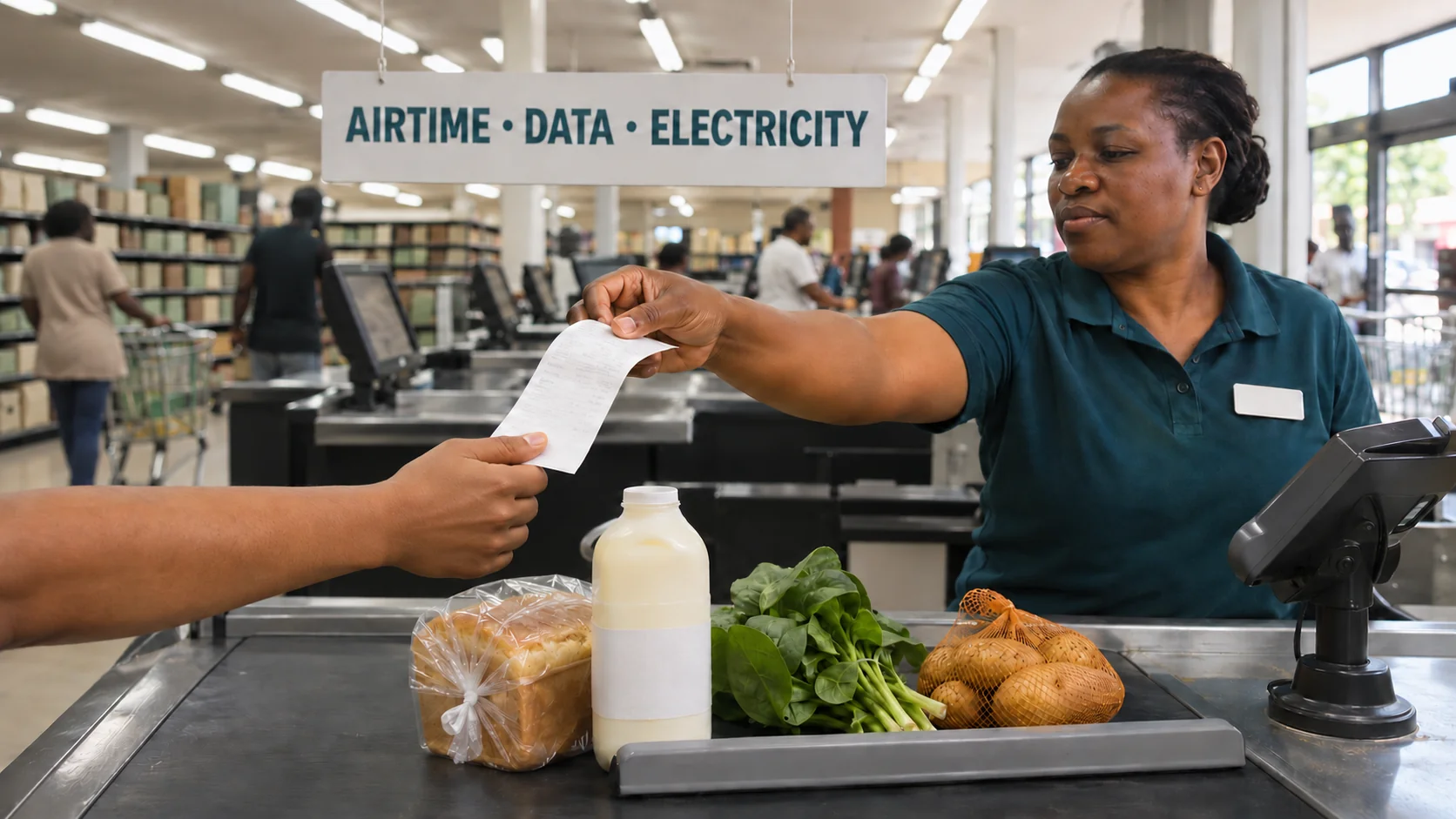
On 9 October 2026, Shoprite added airtime, data and digital vouchers to Sixty60, its grocery delivery app. There was no minimum basket. A customer could buy R10 of airtime on its own and never order a loaf of bread. In announcing the change, Shoprite pointed to the channel it wanted to win from: banking apps, which it said were the preferred channel for 61% of airtime and data purchases (TechCentral).
A grocery retailer competing with banks for airtime sales sounds odd until you look at what South African retailers have built over the past decade. Mr Price started a mobile network in 2014. Pick n Pay launched one on MTN in 2020 and relaunched it with eSIMs in 2025. Shoprite launched K'nect in 2021. TFG launched TFG Connect in 2022. Spar joined in 2025. Pepkor's stores sell about eight in every ten prepaid handsets bought in the country, and its airtime, SIM and data sales reached R9.3 billion in a year. Shoprite has opened a low-cost bank account, a debit card with Investec and a stake in a company whose devices sell airtime in spaza shops.
The retailers are after the same thing the banks want: the most frequent purchase a South African household makes. This case study looks at how each retailer has approached it, what has worked, what has not, and what any business with a customer base, a loyalty programme or a till can take from their experience.
The numbers at a glance
| Figure | Period | Source |
|---|---|---|
| Banking apps: preferred channel for 61% of airtime and data purchases; 95% of consumers surveyed use airtime and data | Cited October 2026 | TechCentral (Shoprite); Bizcommunity (Electrum) |
| Sixty60 sales: R25.5 billion from 997 stores | Shoprite's 2026 financial year | TechCentral, citing the integrated report |
| Shoprite commissions from financial services, Money Market and value-added services: R1.4 billion, up 9.6% | Shoprite's 2026 financial year | TechCentral |
| Shoprite Money Market Account: more than 4 million customers; more than R1 billion in monthly transactions | September to November 2026 | TimesLive; BusinessDay |
| Pepkor airtime, SIM and data sales: R9.3 billion, up 7.8% | Year to 30 September 2025 | TechCentral |
| Pepkor stores' share of prepaid handset sales: about 8 in 10 | Reported May 2025, citing GfK | TechCabal |
| TymeBank TFG Money accounts: 1 million | About a year after launch, February 2024 | TFG |
Why airtime is close to a perfect retail product
Retailers look for products that bring customers in often, cost little to stock and make the rest of the shop easier to sell. Airtime and data meet all of those tests better than almost anything else on the shelf.
People buy them constantly. Prepaid customers top up weekly, sometimes daily, in amounts from R5 to a few hundred rand. A retailer that sells the top-up gets a visit, in store or in an app, far more often than it gets a grocery shop.
They need no storage. Airtime is a digital product delivered instantly. There is no stock to count, no shelf space, no spoilage and no theft from the back room. A retailer can offer every network and hundreds of bundles without a single carton.
Almost everyone uses them. The research Shoprite cited found that 95% of consumers surveyed use airtime and data. Few products in a supermarket can say that.
They create data. A customer who buys airtime with a loyalty card or through an app tells the retailer their network, their typical spend and how often they run out. Combined with basket data, that helps a retailer understand a household's budget.
The margin on each sale is small, and every retailer knows it. Retailers do not sell airtime to get rich on airtime. They sell it for what it does to footfall, loyalty and the basket.
Model one: selling at the till
The oldest model is the simplest. Every large South African retailer sells prepaid airtime, data, electricity and vouchers at its tills or service counters, usually through a specialist distributor that connects the till system to the networks and utilities. For many households, the till at a nearby supermarket was the main place to buy airtime before banking apps took over.
Shoprite turned its service counters into a financial services business. Its Money Market counters handle money transfers, bill payments and prepaid products, and the group's commissions from financial services, Money Market transactions and value-added services rose 9.6% to R1.4 billion in its 2026 financial year (TechCentral). Airtime and electricity are not reported separately, but they are among the products that bring people to the counter.
The till model has two weaknesses. It depends on the customer coming to the store, which they do less often for small purchases now that banking apps make airtime a one-tap job. And it gives the retailer little reason to be chosen over the shop next door, because every till sells the same airtime at the same price. The retailers' later moves are attempts to fix both problems.
Model two: owning a mobile network
From 2014 onwards, retailers started to launch their own mobile virtual network operators. An MVNO rents network capacity from Vodacom, MTN or Cell C and sells it under its own brand, with its own prices and its own link to the retailer's loyalty programme. Specialist enablers handle the technology: billing, SIM management, the app and the connection to the host network. That lets a retailer launch a network without building a telecoms company.
How a retail network is put together
A retailer that launches a mobile network does very little of the telecoms work itself. Four parties are usually involved. The host network, Vodacom, MTN or Cell C, owns the towers, spectrum and core network and sells capacity wholesale. An enabler, sometimes called a mobile virtual network enabler, provides the systems in between: SIM and eSIM management, billing, the customer app, bundle configuration and the technical connection to the host. In the examples below, Huge NXTGN plays that role for Pick n Pay, Frei One Digital for Shoprite's K'nect and megsApp for Spar. The retailer provides the brand, the stores where SIMs are sold, the loyalty programme and the marketing. Customers then need somewhere to recharge, which means the retail network's airtime and data also have to be sold through tills, apps and other channels.
Every SIM has to be registered under RICA before it can be used, which is why retail networks either register customers in store or, like PnP Mobile since 2025, through self-registration in an app with identity verification. Customer support is the hardest part to outsource well. A shopper whose calls drop blames the brand on the SIM, not the host network behind it, so the retailer has to be ready to handle network complaints it cannot fix directly.
The economics depend on volume. The retailer pays the host network for capacity used and pays the enabler for its platform. It earns the difference between those costs and what customers pay, plus whatever loyalty and basket benefits the network brings. A network with a few thousand active users struggles to cover its fixed costs; one with hundreds of thousands can afford to compete on price.
Mr Price, 2014
Mr Price was the first South African retailer to launch a mobile network, in 2014 (TechCentral). Accounts of the early years differ, and the business has changed shape since: in 2020 the group moved away from post-paid contracts to focus on SIM-only products. Mr Price Mobile later became the first MVNO hosted on Vodacom's network (TechCentral), a notable shift in a market where Cell C and MTN host almost all the others.
Pick n Pay Mobile, 2020 and 2025
Pick n Pay launched PnP Mobile in November 2020 as MTN's first MVNO partner, powered by Huge NXTGN, part of the JSE-listed Huge Group (TechCentral). The link to the Smart Shopper loyalty programme was built in from the start: customers who reload at least R20 of airtime or data earn 1MB of free data for every R1 they spend in Pick n Pay stores.
In late July 2025 the retailer relaunched the network with a new app (TechCentral; Bizcommunity). New customers can register, verify their identity and activate an eSIM without visiting a store, using self-RICA. A "build your own plan" feature lets them choose their monthly data, voice and SMS. Loyalty rewards grew too: after six consecutive months, customers earn 5% back on their monthly mobile spend, rising to 10% after nine months.
Shoprite K'nect, 2021
Shoprite launched K'nect Mobile in March 2021 on Cell C's network, with Frei One Digital as its technology partner and an offer of 100MB of free data a month for three months (Shoprite). Its most distinctive feature was expiry: airtime, data and rewards last 60 days instead of the usual 30.
K'nect is closely tied to Shoprite's money products. In March 2023 Shoprite said it had cut K'nect data prices by more than 35% and offered 1GB for R19.50, available daily and only through its Money Market Account, with no transaction fees (Shoprite). Customers who are Xtra Savings members and recharge through the Money Market Account earn extra rewards. The network is a way to move customers into Shoprite's account, and the account is a way to keep them buying airtime and groceries from Shoprite.
TFG Connect, 2022
TFG, the group behind Foschini, Markham, Exact, Jet and @home, launched TFG Connect in September 2022 on MTN's network. Customers can top up in store, online or by USSD, and USSD recharges are billed to their TFG Money account (Bash help centre). TFG Money is itself a partnership with TymeBank: customers open accounts at kiosks in TFG stores, and the account reached a million customers about a year after its January 2023 launch (TFG). The two products reinforce each other: TFG said in 2024 that TFG Connect subscribers could buy airtime and data in the TymeBank app for up to 14% less than through its other channels (TechFinancials).
Spar Mobile, 2025
Spar launched Spar Mobile in May 2025, a prepaid MVNO on MTN's network built with megsApp, which handles billing and service delivery (TechCentral; TechCabal). Like Pick n Pay, it rewards shopping with data, and eSIMs are available so that customers can keep their existing number in a dual-SIM phone.
How the retail networks compare
| Retailer | Network | Launched | Host | Loyalty link |
|---|---|---|---|---|
| Mr Price | Mr Price Mobile | 2014 | Vodacom (its first MVNO) | SIM-only focus since 2020 |
| Pick n Pay | PnP Mobile | November 2020; relaunched July 2025 | MTN | 1MB per R1 spent in store; 5% to 10% back on mobile spend |
| Shoprite | K'nect | March 2021 | Cell C | Cheaper data through the Money Market Account; Xtra Savings rewards; 60-day expiry |
| TFG | TFG Connect | September 2022 | MTN | Billing to TFG Money; lower prices in the TymeBank app |
| Spar | Spar Mobile | May 2025 | MTN | Data rewards for shopping |
Most of the retailers chose MTN. In 2023 BusinessDay reported that MTN was pushing to dominate the MVNO market, and that MVNOs as a whole held about 2% of South Africa's mobile subscribers (BusinessDay). That small share is the honest measure of retail networks so far. They give loyal shoppers a reason to stay, and they create a direct relationship with a subset of customers. They have not displaced the big networks for most people.
What shoppers get, and what they give up
For a shopper, a retail network's appeal is concrete. K'nect's airtime and data last 60 days instead of 30. PnP Mobile turns grocery spending into data and gives cashback on mobile spend after six months. TFG Connect is cheaper through the TymeBank app. Spar rewards shopping with data. For a household that already does its main shop at one of these retailers, those benefits add up to real money over a year.
The costs are less visible. A retail network's coverage is its host's coverage, so a shopper who lives where the host is weak gets a weak signal. Some deals available to the big networks' own customers, such as personalised bundles in their apps, are not available on a retail SIM. And the benefits only work if the shopper keeps shopping at that retailer. A customer who moves house and changes supermarket may find the SIM's rewards stop making sense. Number porting allows the number to move, but it is one more task.
These trade-offs explain why retail networks have grown slowly even when their offers are good. They suit loyal shoppers in areas with strong host coverage. For a retailer that group is worth a great deal, but it is a minority of its customers.
Model three: tying airtime to money
Retailers learned what the banks learned: airtime sells best where the customer's money already is. Shoprite and TFG both responded by putting accounts in their customers' hands.
Shoprite's Money Market Account began as a simple account for sending, saving and spending money at Shoprite and Checkers. By November 2026 it served more than 4 million customers (TimesLive), and BusinessDay reported that it processed more than R1 billion in transactions every month (BusinessDay). In late 2026 Shoprite said it would add a debit card, with Investec providing the banking infrastructure and Shoprite the customer-facing product through its stores and digital channels. Its chief executive said the group would build financial products through partnerships with established financial institutions instead of applying for a banking licence (TechCentral).
TFG went the partnership route from the start, with TymeBank providing the account and TFG providing the stores, the brand and the customers. The 1 million accounts in a year show how quickly a retailer can put a financial product into customers' hands when the account is opened at a kiosk in a store they already visit.
In both cases the account and the airtime help each other. Airtime gives customers a reason to keep money in the account, and the account makes airtime purchases quicker and, in K'nect's case, cheaper. BusinessDay called it Shoprite's great banking flirtation, and prepaid sits at the centre of it.
Model four: airtime in the delivery app
Sixty60's October 2026 launch took the next step. Shoppers can now buy airtime and data for Vodacom, MTN, Telkom, Cell C and K'nect in the app, along with digital vouchers for App Store and iTunes, Google Play, Uber and PlayStation, with no minimum basket (Bizcommunity).
The logic is about habit. Sixty60 generated R25.5 billion in sales in Shoprite's 2026 financial year from 997 stores. Customers who use it weekly for groceries can now buy airtime without switching to their banking app, and customers who open it for airtime may add groceries to their order. Shoprite is betting that the convenience that made banking apps the main channel for airtime will work for a delivery app that people already open often.
Whether it works will show up in Shoprite's future results, which do not yet separate app airtime sales. The bet is a direct challenge to banks, and it shows how much retailers now think the airtime habit is worth.
Model five: reaching the informal economy
Most South African airtime is not sold in supermarkets or apps. A large share is sold at spaza shops, informal stalls and small stores that use vending devices from Flash, Kazang and other providers. Retailers have noticed.
Pepkor owns Flash, which processed about R60 billion through more than 170,000 informal traders in the year to September 2025 and is being merged with Shop2Shop. Shoprite announced in March 2026 that it would buy a 51% stake in R&A Cellular, a company based in eMalahleni, Mpumalanga, whose point-of-sale devices let spaza shops and informal stores sell airtime, electricity and other prepaid products and accept card payments. The deal was completed in August 2026 (TechCentral; Business Report). R&A Cellular was already selling Shoprite vouchers through its devices, and Shoprite plans to add its own financial products to the platform's catalogue.
The informal-trade story is large enough for its own case study, The R60 billion spaza counter. For retailers, the move shows that airtime is a way to reach customers who do not shop in their stores often, through the shops those customers use every day.
The device side: Pepkor's grip on prepaid phones
Pepkor, which owns PEP and Ackermans, holds a position no other retailer can match. Market research firm GfK found that its stores account for about eight out of every ten prepaid handsets sold in South Africa (TechCabal). In the year to September 2025, airtime, SIM and data sales contributed R9.3 billion to the group, up 7.8% (TechCentral).
Pepkor has also changed how people pay for phones. Its FoneYam service lets customers rent a smartphone instead of paying for it upfront. In the six months to March 2026, FoneYam activated 1.3 million new accounts, taking its active base to about 2.4 million, and the rental book grew to R2.6 billion (ITWeb). A customer who rents a phone from PEP, buys a SIM there and tops up there is a customer PEP sees every week.
What has worked and what has not
A decade of retail experiments allows some judgements.
Loyalty links work when the reward is simple
Pick n Pay's "1MB for every R1" is easy to understand and easy to check against a till slip. K'nect's cheaper data through the Money Market Account gives customers a clear reason to use the account. Rewards that customers can explain to a friend in one sentence tend to change behaviour.
Networks reach a minority of shoppers
Retail MVNOs serve a small share of mobile users. Most customers keep their existing network because of coverage, contracts, family plans or habit, and switching a SIM is more effort than switching a supermarket. Retailers that want to reach all their customers through airtime have also kept selling every network's airtime, at the till and in apps.
Accounts and airtime help each other
The fastest growth has come where airtime and money are linked: Shoprite's account, TFG Money and the banks' apps. Customers buy airtime where their money is, and keep money where buying airtime is easy.
The host network matters
Retail networks inherit their host's coverage and reliability. Most chose MTN; K'nect chose Cell C, which spent years restructuring before its 2025 listing; Mr Price moved to Vodacom. A retailer that depends on one network for its mobile brand carries that network's risks, as the banks found.
Convenience beats price for small purchases
Banking apps became the main channel for airtime because they removed effort, not because they were cheaper. Shoprite's Sixty60 move is a bet on the same principle in a different app.
What any business can take from the retailers
A business does not need 997 stores or a mobile network to use these lessons. Consider who could use them at a smaller scale.
A loyalty programme with points that expire unused could reward members in data instead, using the Pick n Pay principle of a simple, visible reward for each rand spent. A fuel station group, pharmacy chain or franchise network could sell airtime, data and electricity in its own app and give customers a reason to open it weekly. An online store could add airtime and vouchers to its checkout and use them as an entry product for new customers. A school, church, club or membership association could let members buy prepaid in its app and keep a small commission or simply offer the convenience as a service. An employer with a staff app could use data as a recognition reward that arrives instantly.
In each case the questions are the ones the retailers faced. Will the business sell prepaid or give it? Which products matter to its customers? How will it link prepaid to the behaviour it wants? And how will it handle the operational work: network checks, failed orders, reversals, receipts and reconciliation?
Build it: sell prepaid in your app or online store
Selling prepaid well requires the same plumbing the retailers rely on.
- A live catalogue of airtime denominations, data bundles for each network, electricity and digital vouchers.
- A network lookup before every airtime or data sale, because ported numbers keep their original prefixes.
- A meter check before every electricity sale.
- Order references, status checks and duplicate protection.
- Receipts, tax invoices and daily reconciliation against your own sales records.
- Clear failure handling, with reversals and messages customers understand.
SIMcloud provides these through its API, with a catalogue of airtime, data, electricity and digital vouchers, a network lookup, a meter check, your own reference on every order and status queries. We charge no fee on airtime, data or vouchers, so you can sell them at the network's price or the voucher's face value. Electricity carries a fee of about 2.9%, capped at R10 a purchase. There are no monthly or setup fees, and tax invoices are generated monthly with a report of every transaction.
How you earn from prepaid is your decision. Most retailers earn from what prepaid does for the rest of the business: more frequent visits, larger baskets, loyalty sign-ups and account balances. If you want a branded purchase flow, a voucher catalogue limited to particular brands or an integration with your loyalty platform, we take on custom work. Our guides to building an airtime platform and building a rewards platform with the voucher API cover the design.
Give it: replace points with data, airtime and vouchers
The retailers' loyalty links are the part of their strategy that transfers best. A business can reward customers in data, airtime or vouchers for the behaviour it wants, without running a mobile network.
Choose a reward unit people understand
Data in megabytes or gigabytes, airtime in rands and vouchers in rands are all easier to understand than points. Pick n Pay's "1MB per R1" works because customers can do the sum themselves. Make sure the unit maps to real products: data rewards have to become actual bundles on the customer's network, so it can be simpler to reward in airtime or to round data rewards to bundle sizes that every network sells.
Deliver quickly
A reward that arrives seconds after the purchase or action feels like a reward. One that arrives at the end of the month feels like admin. Automated delivery through an API makes instant rewards practical.
Get the network right
Number portability means a customer with an 082 number may be on MTN, and the prefix is only a clue. Our analysis of which network a South African number is on found 060 numbers in our sample spread across all four networks. Check the network before you send, or reward in a form that does not depend on it, such as a voucher.
Protect the programme
Rewards attract abuse: duplicate accounts, shared phone numbers and fake referrals. Set limits per number and per period, check unusual patterns and keep a record of why each reward was earned. Phone numbers are personal information under POPIA, so collect consent, explain how numbers will be used and make sure your supplier agreement covers their processing.
SIMcloud can deliver rewards one at a time through the API, in bulk through CSV uploads of airtime, data or vouchers, or on a repeating schedule every 7 or 30 days. Each order carries your reference, so every reward can be traced to the member and the reason it was earned. Our guide to reconciling a digital voucher campaign covers the finance side.
Questions to settle before you link airtime to loyalty
- What behaviour should the reward change? More visits, a bigger basket, a first purchase, a referral or a completed profile each need a different trigger and size.
- What does the reward cost per member per year, and what is the expected change in spend? A reward that costs R20 a month must bring in more than R20 of margin.
- Will members choose their reward, or will you choose for them? Choice between airtime, data and vouchers increases appeal but adds work.
- How will you know each member's network? Ask once, check with a lookup and update when a send fails.
- When will rewards be delivered: instantly, daily or monthly? Instant feels best and needs automation.
- What limits will stop abuse? Set caps per number, per account and per period.
- How will members see what they have earned? A clear history in the app or by SMS prevents support calls.
- Who reconciles rewards with finance, and against which reference?
A loyalty team that can answer these on one page is ready to build. One that cannot will discover the answers through complaints.
What not to copy
Avoid launching a mobile network to solve a loyalty problem. Even with technology partners, an MVNO needs customer support for network issues, regulatory compliance including RICA, and enough subscribers to make wholesale terms work. The retailers that have done it had millions of loyal shoppers to start with.
Avoid rewards you cannot fulfil on every network. A promise of "free data" that works only for one network's customers will disappoint the rest.
Avoid tying rewards to a single supplier without a fallback. A reward that fails to arrive because a supplier is down on a busy weekend damages the programme more than a smaller reward would have. Our article on adding a backup route explains how to avoid that without sending rewards twice.
Timeline
- 2014: Mr Price launches the first retailer-owned mobile network in South Africa.
- November 2020: Pick n Pay launches PnP Mobile on MTN, MTN's first MVNO partner.
- March 2021: Shoprite launches K'nect on Cell C, with 60-day expiry on airtime and data.
- September 2022: TFG launches TFG Connect on MTN, with USSD recharges billed to TFG Money.
- January 2023: TymeBank and TFG launch TFG Money accounts at in-store kiosks.
- March 2023: Shoprite cuts K'nect data prices by more than 35% and offers 1GB for R19.50 through the Money Market Account.
- February 2024: TFG Money reaches 1 million customers.
- May 2025: Spar launches Spar Mobile on MTN. GfK data shows Pepkor stores selling about 8 in 10 prepaid handsets.
- July 2025: Pick n Pay relaunches PnP Mobile with eSIMs, self-RICA and custom plans.
- March 2026: Shoprite announces a 51% stake in R&A Cellular.
- August 2026: Shoprite completes the R&A Cellular deal.
- October 2026: Sixty60 adds airtime, data and digital vouchers with no minimum basket.
- November 2026: Shoprite confirms Investec as the banking partner for a Money Market debit card.
Frequently asked questions
Which South African retailers have their own mobile networks?
Mr Price (Mr Price Mobile), Pick n Pay (PnP Mobile), Shoprite (K'nect), TFG (TFG Connect) and Spar (Spar Mobile) all run mobile virtual network operators.
Which networks do the retail MVNOs use?
PnP Mobile, TFG Connect and Spar Mobile run on MTN. K'nect runs on Cell C. Mr Price Mobile became the first MVNO hosted on Vodacom's network.
Why do retailers sell airtime if the margin is small?
Airtime brings customers back often, needs no stock and supports loyalty programmes, accounts and bigger baskets. Retailers earn mainly from what airtime does for the rest of the business.
Can I buy airtime on Checkers Sixty60?
Yes. Since October 2026, Sixty60 sells airtime and data for Vodacom, MTN, Telkom, Cell C and K'nect, plus digital vouchers, with no minimum basket.
Is a loyalty reward in data better than points?
For many customers it is easier to understand and more useful immediately. It works best when it maps to real bundles on the customer's network and arrives quickly.
Can a small business sell airtime online?
Yes, through a supplier's API or a dashboard. You need a catalogue, network checks, payment, reconciliation and failure handling. SIMcloud charges no fee on airtime, data or vouchers and has no monthly fee.
Do I need a licence to sell airtime?
Selling airtime as a reseller through a registered supplier does not require you to hold a telecoms licence. Operating your own mobile network does involve licensing and regulatory obligations, which is why retailers use host networks and enablers.
Sources
- TechCentral: Shoprite takes on banking apps with Sixty60 airtime (9 October 2026)
- Bizcommunity: Sixty60 adds instant airtime, data and vouchers (12 October 2026)
- TimesLive: Shoprite taps Investec to power its push into banking (10 November 2026)
- BusinessDay: Shoprite tests Money Market debit card (5 September 2026)
- TechCentral: Shoprite and Investec debit card alliance
- BusinessDay: Inside Shoprite's great banking flirtation (12 October 2026)
- Shoprite: Shoprite launches mobile network (2021)
- Shoprite: K'nect data prices (29 March 2023)
- TechCentral: Shoprite closes its bet on the spaza till
- Business Report: Shoprite takes stake in R&A Cellular (16 March 2026)
- Bash help centre: What is TFG Connect?
- TFG: TymeBank and TFG reach 1 million customers (February 2024)
- TechFinancials: TymeBank and TFG partnership (14 February 2024)
- TechCentral: Pick n Pay launches PnP Mobile on MTN
- TechCentral: Pick n Pay relaunches its MVNO
- Bizcommunity: PnP Mobile rolls out app with eSIM and loyalty perks
- TechCentral: Spar Mobile is South Africa's latest MVNO
- TechCabal: Spar Group enters the mobile space (13 May 2025)
- TechCentral: Mr Price launches MVNO
- TechCentral: Vodacom signs its first MVNO customer
- TechCentral: Pepkor tightens its grip on the prepaid phone market
- TechCabal: 8 out of 10 South Africans buy prepaid phones from Pepkor stores (27 May 2025)
- ITWeb: Pepkor drives smartphone sales via FoneYam
- BusinessDay: MTN pushes for MVNO dominance (20 April 2023)
Figures are as published by the companies or reported by the outlets linked above, for the periods stated. SIMcloud is not affiliated with any retailer, network or company named in this article. Product names are used only to identify them.