
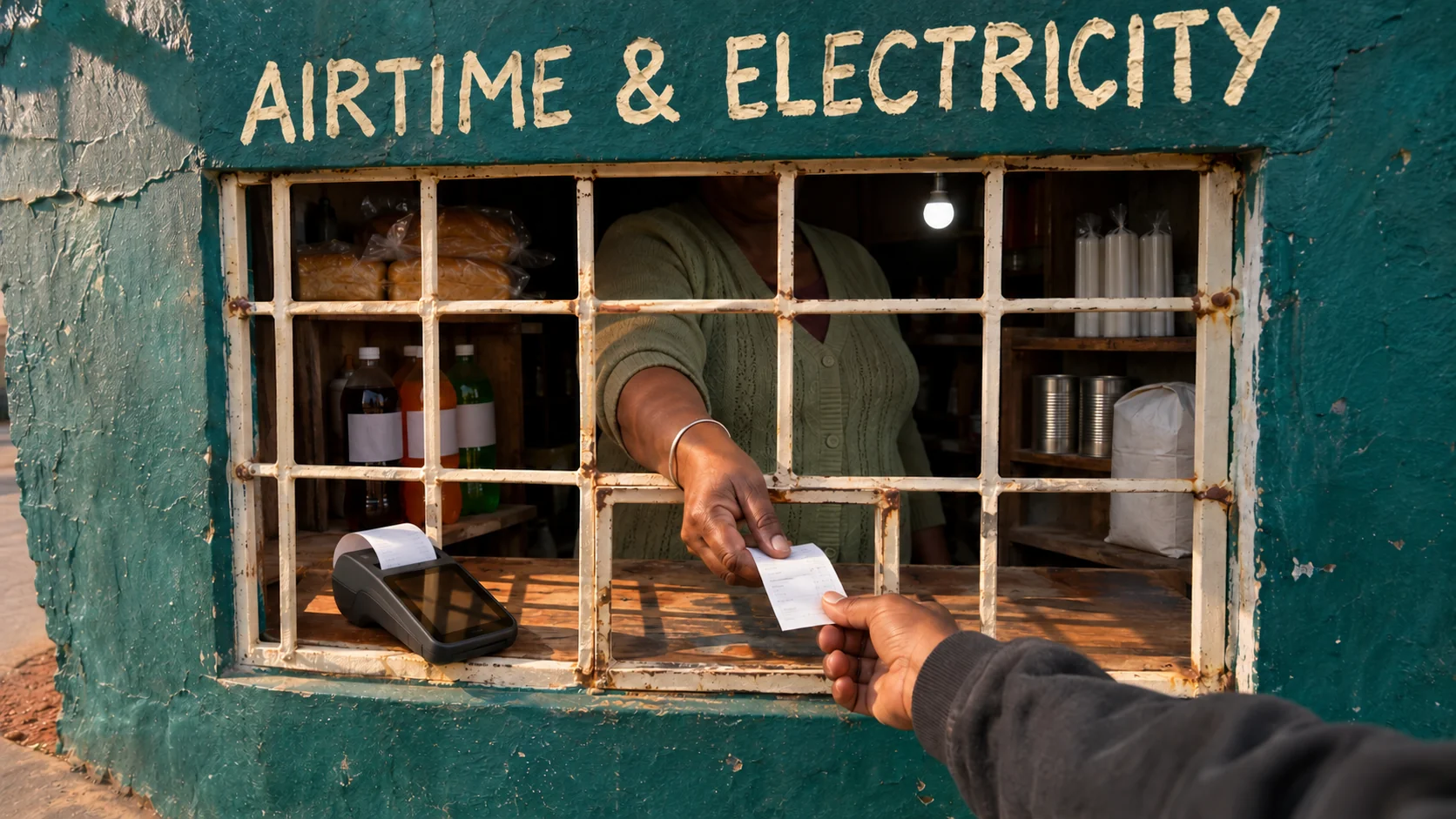
Most of South Africa's prepaid value is still sold across a counter. A customer walks into a spaza shop with a R20 note and asks for airtime, or reads out a meter number from a scrap of paper and asks for R100 of electricity. The owner taps it into a small device next to the till, a slip prints, and the customer leaves with bread, a cold drink and the token they came for. It takes less than a minute and happens tens of millions of times a month.
Behind those counters sit some of the largest payments businesses in the country. Pepkor's Flash processed about R60 billion through more than 170,000 informal traders in the year to September 2025. Lesaka, listed in New York and Johannesburg, says its Kazang business trades through 68,000 active devices in South Africa. In 2026 Pepkor proposed merging Flash with Shop2Shop into a fintech business valued at about R21.3 billion, and Shoprite bought a majority stake in R&A Cellular, whose devices put airtime and electricity into spaza shops. MTN and Vodacom are courting the same traders with mobile money.
This case study explains how the spaza counter became one of the most contested pieces of retail real estate in South Africa, why airtime and electricity sit at its centre despite thin margins, and what traders, wholesalers and other businesses can learn from the companies fighting over it.
The numbers at a glance
| Figure | Period | Source |
|---|---|---|
| Flash throughput: about R60 billion, up 23%, from more than 170,000 active traders | Year to 30 September 2025 | BusinessDay |
| Flash card payments ("tapped value"): up 37.6% to about R21 billion | Year to 30 September 2025 | BusinessDay |
| Flash transaction value: R34.7 billion, up 20.3%, from about 176,000 traders | Six months to 31 March 2026 | ITWeb |
| Proposed Flash and Shop2Shop merger: combined value about R21.3 billion; Pepkor to hold 57.1% | Announced July 2026 | Business Report |
| Kazang: 68,000 active devices in South Africa | Company website | Kazang |
| Lesaka merchant division revenue: R8.61 billion, down 10%; segment adjusted EBITDA R602 million, down 6% | Year to June 2026 | EWN |
| Shoprite takes 51% of R&A Cellular, whose devices let spaza shops sell airtime and electricity | Announced March 2026; completed August 2026 | TechCentral |
| MTN MoMo Pay for informal merchants: 0.5% transaction fee | Launched May 2025 | TechCabal |
How a vending counter works
A trader who sells prepaid needs three things: a device or app, a supplier and a float. The device is usually a small terminal with a screen, keypad, printer and mobile connection, supplied by a vending company such as Flash, Kazang or R&A Cellular. Some traders use an app on a phone instead. The supplier is the vending company itself, which holds the agreements with the mobile networks, Eskom and the municipalities, and passes the trader's requests to them. The float is money the trader deposits with the supplier in advance, from which each sale is deducted.
When a customer asks for R50 of MTN airtime, the trader selects the network and amount, enters the customer's number and confirms. The device sends the request to the supplier, which deducts the cost from the trader's float and sends the recharge to MTN. MTN credits the phone and the device prints a slip. The customer pays the trader R50 in cash or by card. The trader's earnings are the difference between what the customer paid and what the float was charged, usually a small percentage set by the supplier for each product.
Electricity works similarly, with two differences. The trader enters a meter number instead of a phone number, and the supplier returns a 20-digit token, which prints on the slip for the customer to type into the meter. Some purchases also return key change tokens or free basic electricity tokens, which must be entered in the right order. Our guide to selling prepaid electricity from a shop explains the process from the counter.
Card acceptance has become the second job of many of these devices. Flash's "tapped value", the amount customers paid by card at Flash traders, rose 37.6% to about R21 billion in the year to September 2025. A device that sells airtime can also take a card payment for groceries, which saves the trader from turning away a customer without cash.
Why airtime and electricity, of all things
Airtime and electricity are necessities bought in small amounts, often several times a week. In a household that receives income weekly or monthly in cash, a R10 top-up or a R50 electricity token is a normal purchase, and the nearest place to buy it is often the spaza shop down the road.
Many prepaid customers do not use banking apps for these purchases, or do not always have data or balance to do so. Cash is still common in township retail: MTN said when it launched MoMo Pay that more than 95% of transactions in the informal sector were cash-based (TechCabal). A counter where a customer can turn cash into airtime or electricity in seconds meets a need that apps do not fully cover.
Proximity and trust matter too. A spaza owner knows regular customers, can help someone who is unsure how to load a token, and is open at hours when malls are closed. When a meter runs out at 21:00 on a Sunday, the nearest open counter decides where that customer buys.
For the trader, prepaid is a footfall product. The margin on R50 of airtime is a few rand at most, but the customer who comes for airtime often buys something else. Airtime and electricity also give the trader a reason to install a device, and once the device is there it can take card payments, pay bills and, increasingly, provide credit and stock ordering.
The counter's calendar
Trade at a prepaid counter follows the household calendar. Salaries paid on or around the 25th bring the busiest days of the month, when customers settle what they owe, buy larger electricity tokens and top up airtime for the weeks ahead. Social grants are paid early in each month, which brings a second rush in many communities. In between, purchases shrink to the smallest amounts: R5 and R10 of airtime, R20 or R50 of electricity, bought when the meter beeps or the balance runs out.
The day has a rhythm too. Mornings bring airtime for work calls and data for commuters. Evenings bring electricity, especially in winter when heaters, kettles and geysers run longer and meters run down faster. Weekends bring larger household purchases and, for electricity, the moments when nobody wants to be in the dark. A counter that is open late and has float available at those times wins customers who might otherwise wait or go elsewhere.
These patterns matter for float. A trader who runs out of float on the 25th or on a cold Sunday evening loses the biggest sales of the month. Experienced traders top up before the busy days, and vending platforms that let float reflect quickly, including after hours, have an advantage.
How the money flows
| Step | What happens | Who holds the money |
|---|---|---|
| Before the sale | The trader deposits float with the vending supplier. | The supplier, on the trader's behalf |
| The sale | The customer pays the trader in cash or by card. The device debits the trader's float. | The trader holds the cash; card money is settled to the trader later |
| Fulfilment | The supplier sends the order to the network or utility, which issues the airtime or token. | The supplier settles with the network or utility under its own agreement |
| Earnings | The trader earns the commission set by the supplier for that product. | Usually reflected in the float or a separate statement |
| Failure | If the network or utility rejects the order, the supplier reverses the debit. | The float is restored; the trader returns the customer's money |
Every party in this chain earns a share of the face value. The networks and utilities set the overall discount available, the supplier keeps part of it, and the trader receives the rest as commission. When the networks or utilities cut that discount, or when competition between suppliers pushes it down, the squeeze is felt along the chain, which is what Lesaka described when it pointed to airtime margin compression.
Flash: from vending to a fintech platform
Flash built its business on informal traders. It sells airtime, data, electricity, bill payments, money transfers and its 1Voucher product through devices and apps used by spaza shops, salons, taxi rank vendors and home businesses. Pepkor, the group behind PEP and Ackermans, owns it and has made the informal market a strategic priority. BusinessDay reported in January 2025 that Pepkor saw the informal market as a key growth area (BusinessDay).
The numbers have grown quickly. Throughput rose 23% to about R60 billion in the year to September 2025, and card payments through Flash traders rose 37.6% to about R21 billion. In the six months to March 2026, Flash processed R34.7 billion, up 20.3%, from about 176,000 traders. Spread over a year, R60 billion is about R164 million a day across the network, which gives a sense of how much ordinary household spending now passes through informal counters with a Flash device.
In July 2026 Pepkor proposed combining Flash with Shop2Shop, a platform that gives informal businesses digital payments, ways to pay suppliers and working capital. Pepkor would hold 57.1% of the combined company. The deal values Flash at about R10.6 billion and the whole business at about R21.3 billion, and Pepkor has said it plans to list it on the JSE in the medium term (Business Report). Shop2Shop had already partnered with Pay@ to turn corner shops into places where people can pay a wide range of bills (Bizcommunity).
The strategy is visible in the deal. Airtime and electricity bring the trader onto the platform. Card acceptance and bill payments add transactions. Supplier payments and working capital make the platform part of how the shop buys its stock. Each layer earns more and makes it harder for the trader to leave.
Kazang and Lesaka: consolidation and a reset
Lesaka Technologies, formerly Net1, has assembled one of the largest merchant groups in the country through acquisitions. It bought Connect Group in 2022, completed the purchase of the card-acceptance business Adumo on 2 October 2024 (TechCentral), completed the R507 million purchase of the electricity submetering business Recharger in March 2025 (Lesaka), and agreed to buy Bank Zero in 2025, subject to regulatory approval. Kazang, its vending business, says it trades through 68,000 active devices in South Africa.
Airtime has been the hard part. In 2025 Lesaka's merchant division reported lower revenue, and its chief executive pointed to weaker airtime volumes and margin compression in the airtime market (TechCabal). In the year to June 2026, Lesaka returned to profit for the group as a whole, but merchant revenue fell 10% to R8.61 billion and the division's adjusted EBITDA fell 6% to R602 million as the company worked to integrate four acquired businesses and simplify its operations (EWN).
Lesaka's experience is the counterpoint to Flash's growth. Airtime volumes can stall when customers move to banking apps, when networks change their own channels or when competition pushes margins down. A vending business that depends heavily on airtime feels those shifts directly. Lesaka's response has been to grow in card acceptance, electricity and lending, where the economics are better.
New entrants at the counter
Shoprite and R&A Cellular
Shoprite announced in March 2026 that it would take 51% of R&A Cellular, a privately held company based in eMalahleni, Mpumalanga, whose point-of-sale devices let spaza shops and informal stores sell prepaid airtime, electricity and other products and accept card payments. The deal was completed in August 2026 (TechCentral; Business Report). R&A Cellular was already selling Shoprite vouchers through its devices, and Shoprite plans to add its own financial services to the platform's catalogue. For South Africa's largest grocer, the device on the spaza counter is a way to reach customers who do not shop in its stores every week.
MTN MoMo Pay
MTN launched MoMo Pay in May 2025 as a low-cost way for informal merchants to accept payments by QR code, merchant ID or payment request, with a 0.5% transaction fee (TechCabal; Engineering News). MTN said it planned to add microloans, savings and insurance over time. It entered a crowded field: Yoco, iKhokha, Kazang and others already serve small merchants with card machines.
Vodacom VodaPay
Vodacom's VodaPay super-app also targets small merchants and consumers, with payments, insurance and lending. Our companion case study on how the networks are becoming financial services companies covers VodaPay and MoMo in detail.
Registration and the pressure to formalise
In November 2024, after a series of food-poisoning deaths of children linked to food bought at spaza shops, the government required spaza shops and other food-handling businesses to register with their municipalities within 21 days. The deadline was later extended to 28 February 2025 (SAnews). By early December 2024, 51,788 spaza shops had registered, according to figures reported by Daily Maverick (Daily Maverick). Government said after the February deadline that it would not be extended again.
Registration has nothing directly to do with airtime, but it changes the environment for the companies serving traders. Registered businesses are easier to verify, and a trader who has to keep records for a municipality is more likely to value a device that records every sale. Payments platforms have presented their services as tools that help traders run more formal, safer businesses, with fewer cash risks and better records. Shop2Shop's chief business officer, Annelene Dippenaar, told EWN that its system would help traders reduce cash risks and strengthen working capital (EWN).
The economics for a trader
For a spaza owner, prepaid is rarely a big earner on its own, and it is worth being clear about why.
Commission on airtime is a small percentage of the sale, set by the supplier and varying by network and product. On a R20 sale, the trader may earn well under a rand. Electricity commissions vary by supplier and utility. The trader has to keep enough float with the supplier to serve customers through the busiest days, which ties up cash. Devices may carry rental or purchase costs, and card payments carry fees. Cash in the shop is a security risk.
What the trader gains is traffic and convenience. Customers who know they can always get airtime and electricity at one counter come back, and they buy other things while they are there. A device that also accepts cards means the trader does not lose sales to customers without cash. For many owners, those indirect benefits are why they sell prepaid at all.
Our guide to airtime reseller profit works through the maths in detail, and our guide to starting an airtime and electricity business compares the commercial models. Both make the same point: plan on the margin you will really earn after costs, and treat prepaid as part of a wider offer.
A trader's checklist for choosing a vending supplier
- What commission do you pay on each product and network, in writing?
- Are there device rental, purchase, monthly or minimum-volume fees?
- How do I deposit float, how quickly does it reflect, and what happens over weekends?
- What happens when a sale fails or the device loses signal mid-sale? How are reversals handled?
- Can I see my full transaction history and export it?
- What are the card acceptance fees, and when is card money paid out?
- Does the agreement restrict me from using other suppliers?
- Who do I call when the device or platform is down, and when are they available?
What goes wrong at the counter, and how to handle it
A device can lose signal halfway through a sale. The safest response is to check the device's transaction list, or call the supplier, before selling again. If the first sale went through, a second sale means the customer receives the airtime twice and the trader pays twice.
A customer can give the wrong number or meter. A recharge to a wrong number usually cannot be recovered, and a token for the wrong meter cannot be used on another meter. Reading the number back to the customer before confirming prevents most of these mistakes.
A number may be on a different network from the one its prefix suggests, because numbers can be ported. If a recharge fails for that reason, the money is reversed, and the trader should try the correct network. A quick network check avoids the failed attempt.
A meter can reject a token. Sometimes the token was entered incorrectly, sometimes key change tokens must be entered first, and sometimes the meter needs attention from the utility. Our guide to tokens that do not work covers the common causes.
Float can run out at the worst time. Keeping a buffer above the busiest day's sales, and knowing how long a deposit takes to reflect, prevents lost sales.
The platform itself can be unavailable. When that happens, a trader with no other channel has nothing to sell. Keeping a second way to sell, even a small account on a phone, means the counter stays open.
Why big groups still want the counter
If airtime margins are thin and some vending businesses have struggled, why are Pepkor, Shoprite, Lesaka, MTN and Vodacom all competing for the spaza counter? Because the counter is a distribution point for much more than airtime.
A device in a shop sees every sale it processes. Over time, that data shows how much the shop trades, how reliably and when. That history can support working capital loans for stock, which Shop2Shop already offers. The same device can sell insurance, accept card payments for every purchase, let customers pay municipal bills and send money to family. Each new service earns a fee and makes the device more central to the shop's day.
For a retailer like Shoprite, the counter also reaches customers who live far from its stores. For the mobile networks, it is a way to bring traders and their customers into mobile money. For Pepkor, it extends a business that already sells most of the country's prepaid handsets into the shops where those handsets are recharged.
Airtime and electricity get the device onto the counter, and the services added afterwards earn most of the money.
What the spaza counter teaches
Necessity products open doors
Airtime and electricity are not the most profitable products on a spaza counter, but they are the most reliable reason for a customer to visit. Platforms that wanted to reach informal traders started with them for that reason.
Margins move, so depend on more than one product
Lesaka's airtime squeeze shows what happens when one product carries too much of a business. Flash's growth has come with card payments and bill payments alongside airtime.
Proximity beats technology for some customers
Banking apps have taken a large share of airtime sales, but cash customers, customers without data and customers who want help still choose a nearby counter. Those customers are numerous enough to support businesses processing tens of billions of rand.
The relationship is the asset
Every group in this story is trying to own the relationship with the trader, through devices, float, payments, stock and credit. A trader who uses one platform for everything earns that platform fees on every service and is hard to win away.
Consolidation reduces choice
The Flash and Shop2Shop merger, Lesaka's acquisitions and Shoprite's stake in R&A Cellular mean fewer, larger platforms. That can bring better services, and it also means more traders depend on fewer systems. A trader whose only device is offline on a Friday night has no other way to serve customers, which is why some traders keep a second channel.
What this means for other businesses
The spaza counter story matters beyond the informal sector.
Wholesalers and fast-moving consumer goods distributors that supply informal traders can add prepaid to their trader relationships, giving traders a reason to deal with them more often and gathering data on which shops trade most.
Enterprise development programmes and NGOs that support small businesses can help traders compare suppliers on written terms, understand their margins and keep a backup channel.
Landlords of township shopping centres, taxi rank operators and market managers can offer prepaid services to the people who use their sites every day.
Fintech companies building for small merchants can add airtime and electricity as entry products, then build payments and credit on top, as Flash and Shop2Shop have done.
And a spaza owner already using one platform can protect their trade with a second way to sell when the first is unavailable.
Build it: a prepaid platform for a trader network
An organisation that supplies or supports many traders can give them prepaid without building connections to every network and utility. It needs a supplier with a complete catalogue, a way to separate each trader's sales and float, and reports that show who sold what.
SIMcloud's API covers airtime, data, electricity and vouchers, with your own reference on every order, status queries, a balance endpoint and transaction history. Business accounts can add separate logins for staff, so each person's orders are recorded against them. For a trader network, the platform you build on top would hold each trader's float and pricing, send orders through the API with a reference that identifies the trader, and reconcile daily. Our guide to building an airtime distribution platform covers the design, and we take on custom work where a network needs something the standard API does not provide.
Sell it: a second channel for the counter
A spaza owner with a Flash, Kazang or R&A Cellular device can keep a SIMcloud account on a phone as a second way to sell when the device is offline. Register free, fund a small float by PayShap, Ozow or EFT, and buy airtime, data or electricity for customers from the phone. Electricity tokens can be sent to the customer by SMS.
Be clear about the economics. SIMcloud sells airtime and data at face value, so a sale made through SIMcloud earns the trader no commission. On electricity, our fee of about 2.9%, capped at R10, comes out of the amount, so the customer receives slightly fewer units than the full amount would buy. The benefit is keeping the customer who would otherwise walk to the next shop. Our guide to adding a backup route has a section for traders, including how to avoid selling the same thing twice when a device comes back online.
Timeline
- 2022: Lesaka buys Connect Group.
- 2 October 2024: Lesaka completes its acquisition of Adumo.
- November 2024: Lesaka agrees to buy Recharger. Government gives spaza shops 21 days to register after child food-poisoning deaths.
- January 2025: Pepkor names the informal market as a growth priority.
- 28 February 2025: Extended spaza registration deadline.
- March 2025: Lesaka completes the Recharger acquisition.
- May 2025: MTN launches MoMo Pay for informal merchants at a 0.5% fee.
- November 2025: Pepkor reports Flash throughput of about R60 billion for the year to September 2025.
- March 2026: Shoprite announces a 51% stake in R&A Cellular.
- July 2026: Pepkor proposes merging Flash and Shop2Shop.
- August 2026: Shoprite completes the R&A Cellular deal.
- September 2026: Lesaka reports a group profit for the year to June 2026, with lower merchant revenue as the division resets.
Frequently asked questions
Who owns Flash?
Flash is owned by Pepkor, the group behind PEP and Ackermans. In July 2026 Pepkor proposed merging Flash with Shop2Shop into a new fintech company in which it would hold 57.1%.
Who owns Kazang?
Kazang is part of Lesaka Technologies, which is listed in New York and Johannesburg and also owns Connect, Adumo and Recharger.
How much does a spaza shop earn from selling airtime?
Commission is a small percentage of each sale, set by the supplier and varying by network and product. Most traders sell airtime and electricity mainly for the customers it brings in.
Do spaza shops have to register?
Government required spaza shops and other food-handling businesses to register with their municipalities, with a final deadline of 28 February 2025.
What is MoMo Pay?
MoMo Pay is MTN's payment service for informal merchants, launched in May 2025, which lets them accept payments by QR code, merchant ID or payment request for a 0.5% fee.
Can a trader use more than one vending supplier?
Check the supplier agreement for exclusivity. Many traders keep a second way to sell, such as an app on a phone, for times when their main device is offline.
Can I sell electricity tokens from my phone?
Yes. With a SIMcloud account you can buy a token for a customer's meter and send it to their phone by SMS. Check that the meter is supported before taking the customer's money.
Sources
- BusinessDay: Pepkor's Flash and its informal traders (26 November 2025)
- ITWeb: Fintech turns standout performer for Pepkor
- Business Report: Flash to merge with Shop2Shop (22 July 2026)
- BusinessDay: Pepkor targets informal market (22 January 2025)
- Bizcommunity: Shop2Shop and Pay@ partnership
- EWN: Shop2Shop helps informal traders embrace digital payments (30 June 2026)
- Kazang: Who is Kazang
- TechCentral: Lesaka completes Adumo acquisition
- Lesaka: Lesaka buys prepaid electricity vendor for R507m
- TechCabal: Lesaka's merchant slowdown
- EWN: Lesaka returns to profit as merchant division resets (14 September 2026)
- TechCentral: Shoprite closes its bet on the spaza till
- Business Report: Shoprite stake in R&A Cellular (16 March 2026)
- TechCabal: MTN's MoMo Pay enters the market with a 0.5% fee (21 May 2025)
- Engineering News: MTN launches MoMo Pay for informal merchants
- SAnews: Spaza registration deadline extended to February 2025
- Daily Maverick: Spaza registration extended (18 December 2024)
Figures are as published by the companies or reported by the outlets linked above, for the periods stated. SIMcloud is not affiliated with Pepkor, Flash, Shop2Shop, Lesaka, Kazang, Shoprite, R&A Cellular, MTN, Vodacom or any other company named. Product names are used only to identify them.