
South Africa's mobile networks carried 21.5% more voice traffic in 2025 than the year before, and earned R10.4 billion less from mobile services. ICASA's 2026 State of the ICT Sector report found that total mobile services revenue fell 7.9% to R121.9 billion in the year to September 2025, as calls and messages moved to WhatsApp and other internet apps. Messaging revenue alone fell from R4.1 billion to R2.6 billion (TechCentral).
The networks have seen this coming for years, and their answer has been to become something more than networks. Vodacom reported 103 million active financial services users across its markets in the year to March 2026, and its South African fintech business, anchored by the VodaPay app, earned R3.7 billion (TechCentral). MTN launched MoMo Pay for informal merchants in South Africa in 2025, while cutting back on the airtime credit that had become a large share of its prepaid business. Both now sell insurance, lend money, process payments and host other companies' services inside their apps.
The banks became mobile networks, as our case study on Capitec, FNB and the bank-run mobile network describes. This case study looks at the other direction: how the networks are becoming financial services companies, what they have achieved, where they have struggled and what it means for businesses that sell to the same customers.
The numbers at a glance
| Figure | Period | Source |
|---|---|---|
| South African mobile services revenue: down 7.9% to R121.9 billion; messaging revenue down from R4.1 billion to R2.6 billion | 12 months to 30 September 2025 | TechCentral, on ICASA's report |
| Prepaid data revenue: up 7.7% to R42.1 billion | 12 months to 30 September 2025 | TechCentral, on ICASA's report |
| Vodacom: 103 million active financial services users across its markets | Year to 31 March 2026 | TechCentral |
| Vodacom South Africa fintech revenue, anchored by VodaPay: up 8.1% to R3.7 billion; 15.3 million users; about 3 million insurance policies | Year to 31 March 2026 | TechCentral |
| Vodacom: Airtime Advance about half of South African prepaid recharges | Year to 31 March 2026 | TechCentral |
| MTN South Africa fintech revenue, including XtraTime: down 16.3% to R701 million | Six months to June 2026 | TechCentral |
| MTN MoMo Pay for informal merchants: 0.5% transaction fee | Launched May 2025 | TechCabal |
Why networks want to be wallets
A mobile network's traditional business is selling calls, SMS and data. Two of those three are shrinking. People call on WhatsApp and send messages on WhatsApp, and every minute or message that moves to an internet app is one the network no longer bills directly. ICASA said the declines in SMS and voice revenue were consistent with long-term substitution towards these apps. Data still grows, but data prices have fallen under regulatory and competitive pressure, so growth in usage does not translate into equal growth in revenue.
The networks have advantages in financial services that few other companies can match. They have a relationship with almost every adult in the country, many of them prepaid customers with no other formal financial product. They know, from airtime and data purchases, how much each customer spends and how regularly. They have tens of thousands of airtime dealers and stores that can register customers and handle cash. And their customers' phones are already the device on which a digital wallet would live.
Vodacom has turned that into a stated strategy. BusinessDay reported in May 2026 that Vodacom was moving closer to its 2030 goal for revenue from services beyond mobile connectivity (BusinessDay). MTN's group strategy also puts fintech and digital platforms alongside connectivity.
Vodacom: insurance, VodaPay and airtime advances
Vodacom's financial services business is large because of M-Pesa, the mobile money system run by Safaricom in Kenya and by Vodacom in several other African markets. Across the group, Vodacom reported 103 million active financial services users in the year to March 2026, and M-Pesa and VodaPay together processed transactions worth US$525.6 billion (TechCentral). From 30 June 2026, Vodacom has consolidated Safaricom as a subsidiary, and it reported 108 million financial services customers at its half-year (TimesLive).
In South Africa the business looks different. M-Pesa itself never took hold in South Africa the way it did in Kenya, because South Africans already had widespread access to bank accounts. Vodacom's South African fintech is built around the VodaPay super-app, which combines payments, a marketplace of third-party services, insurance and lending. In the year to March 2026, the South African fintech business grew revenue 8.1% to R3.7 billion, with 15.3 million users. Insurance was the largest driver, with about 3 million policies across contract, device, funeral and life cover (TechCentral).
Why M-Pesa did not work in South Africa
Vodacom launched M-Pesa in South Africa in 2010 with Nedbank and closed it in 2016 after it failed to reach its targets. The reasons are instructive. In Kenya, M-Pesa filled a gap: most people had no bank account, and sending money to family upcountry was slow and risky. In South Africa, most adults already had access to a bank account, banks were rolling out cheap accounts and app-based transfers, and retailers already offered money transfers at their tills. Regulation also required mobile money to run in partnership with a bank, which limited how far a network could go on its own.
VodaPay is Vodacom's second attempt, designed for that market. It does not try to replace bank accounts. It offers payments, insurance, lending and a marketplace of other companies' services, and it earns from what customers buy inside the app.
VodaPay is built as a platform for other businesses as well as for Vodacom's own services. Vodacom's integrated report says that its financial services platforms, including M-Pesa and VodaPay, host a combined 221 mini apps from other providers, serving 9.4 million active financial services app users. A retailer, insurer or service business can reach Vodacom's customers inside the app without building its own.
Airtime Advance is the other pillar. About half of Vodacom's South African prepaid recharges in the year to March 2026 were advances, according to its integrated report, and Vodacom has named Airtime Advance among the contributors to growth in its South African financial services. For Vodacom, advances keep customers active between paydays, earn a fee and give it a lending relationship with millions of prepaid customers. Our case study on the airtime advance economy looks at the costs and the debate.
MTN: MoMo Pay and a reset on credit
MTN's mobile money business, MoMo, is large across Africa. MTN reported 70 million Mobile Money customers across its markets at the end of 2025 (MTN Group). In South Africa, as with Vodacom, mobile money has had to compete with an established banking system.
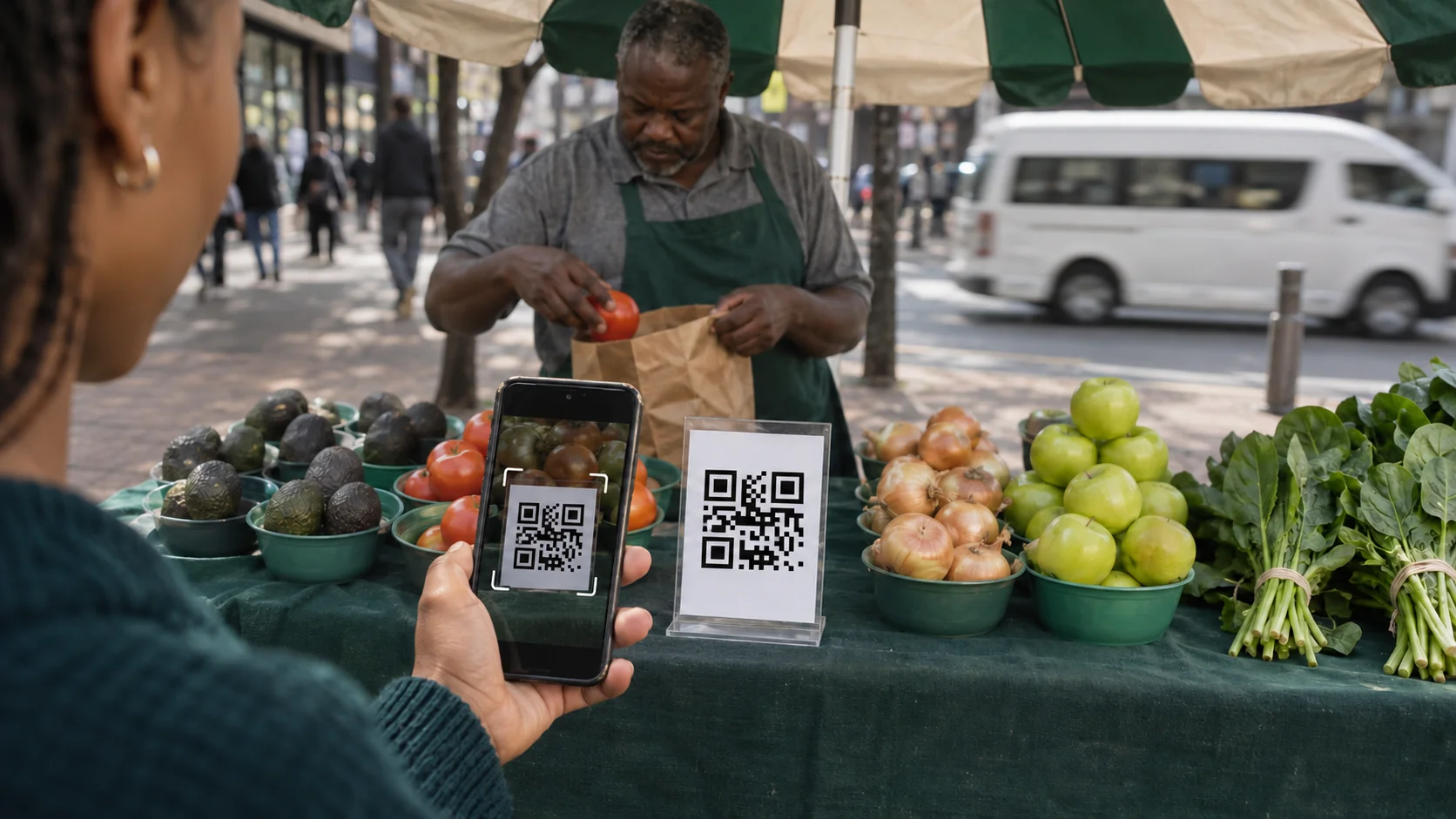
MTN's South African push in 2025 targeted the informal sector. MoMo Pay lets informal merchants accept payments by QR code, merchant ID or payment request, with a transaction fee of 0.5% (TechCabal; Engineering News). MTN said more than 95% of informal-sector transactions were cash-based, and that it planned to add microloans, savings and insurance for merchants over time. It entered a market where card-acceptance companies such as Yoco, iKhokha and Lesaka's Kazang were already established, and where Pepkor's Flash and Shoprite's R&A Cellular serve traders with vending devices. Our case study on the spaza counter covers that competition.
At the same time, MTN reduced its reliance on airtime credit. Over the year to mid-2026 it cut the share of prepaid recharges funded by its XtraTime credit product from 42% to about 34%. The change cost it 1.1 million prepaid customers in a quarter, and South African fintech revenue, which includes XtraTime, fell 16.3% to R701 million in the six months to June 2026 (TechCentral). MTN said it wanted a customer base that was less dependent on airtime credit.
MTN has also moved to sell airtime directly to banks. In August 2026 it said it planned to deal directly with South African banks on airtime, and Blu Label's co-CEO told TechCentral that MTN already did so with every bank except Capitec (TechCentral). Owning the relationship with the banks that sell its airtime gives MTN more control over pricing and data.
Telkom and Cell C
Telkom's mobile business has followed some of the same paths on a smaller scale. It disclosed that airtime advances made up 24.7% of its prepaid recharges, across 4.4 million active users (TechCentral). Cell C has taken a different route, becoming the host network for many virtual operators, including Capitec Connect, and listing on the JSE in November 2025 (JSE). Where Vodacom and MTN build their own financial services, Cell C earns from the banks' and retailers' mobile ambitions.
Why insurance became the networks' best financial product
Of all the financial products the networks sell, insurance has grown most reliably. Vodacom's South African fintech business had about 3 million policies across contract, device, funeral and life cover in the year to March 2026, and insurance was its largest growth driver. At its half-year to September 2026, Vodacom said insurance revenue in South Africa grew by about 18% (TimesLive).
Insurance suits a network for several reasons. Device insurance attaches naturally to the sale of a phone or contract. Premiums can be collected through an existing monthly bill or debit, so customers do not need to set up a new payment. Funeral cover is a product South African households already understand and value, and a network can sell it to millions of customers through channels it already runs. Claims for small policies are relatively simple to process at scale. And the network does not have to carry the risk itself: it can partner with a licensed insurer and earn a share of premiums for distribution.
Lending is harder. Airtime advances work because the amounts are tiny and repayment comes automatically from the next recharge. Larger loans need credit assessment, collections and compliance with consumer credit law, which is why networks tend to offer them through marketplaces or partners.
Where customers can now buy prepaid and pay
| Channel | Examples | What it is good at |
|---|---|---|
| Banking app | Capitec, FNB, Standard Bank, Absa, Nedbank, Discovery Bank | One tap from the account balance; rewards; advances for some clients |
| Network app | VodaPay, MTN's apps | The network's own bundles and offers; insurance and lending; merchant payments |
| Retailer account or app | Shoprite Money Market Account, Sixty60, TFG Money | Linked to shopping and loyalty; cheaper bundles on some retail networks |
| Counter with a vending device | Spaza shops and small stores using Flash, Kazang or R&A Cellular devices | Cash customers; help at the counter; open late nearby |
| Wallets, payroll and loyalty apps | Fintech wallets and apps that sell prepaid through a supplier | Prepaid as a reason to open the app; rewards and benefits |
Most customers use more than one of these. The competition between them is about which one they use first, and which one keeps their money between purchases.
Where networks and banks meet
The networks and the banks are now competing for the same customer from opposite directions. Capitec runs a mobile network on Cell C and lends airtime across networks. Vodacom sells insurance, lends money and hosts a marketplace in VodaPay. MTN takes merchant payments with MoMo Pay. FNB sells devices and solar through FNB Connect. Shoprite, a retailer, offers an account, a debit card with Investec and a mobile network.
Each has a different starting advantage. The banks hold the customer's salary and can see their whole financial life. The networks hold the customer's phone number and usage, reach people without bank accounts and have physical distribution in every township and town. The retailers have stores and loyalty programmes that millions use weekly.
For consumers, the competition has brought cheaper data from bank networks, more ways to buy airtime and more insurance and credit products aimed at prepaid customers. It has also brought more ways to borrow small amounts, and the airtime advance figures show how many people use them. For businesses, the competition means more channels through which customers pay and buy, and more platforms that want to host their services.
What the networks' push teaches
Declining core revenue forces new businesses
The networks moved into financial services because voice and SMS revenue were falling. Any business whose main product is being replaced by something free should look at what else its customer relationship can support.
Distribution and data are the assets
What the networks bring to financial services is reach, physical presence and knowledge of how customers spend on airtime and data. Those assets let them lend and insure at scale where banks have struggled to reach.
Credit growth carries risk
Vodacom leans on airtime advances; MTN has cut back. The same product can be a growth engine for one company and a risk to manage for another, depending on how it is priced and to whom.
Platforms invite partners
VodaPay hosts hundreds of mini apps from other companies. A platform that lets others sell to its users grows faster than one that tries to build everything itself.
Local conditions decide what works
M-Pesa transformed Kenya and made far less impact in South Africa, where banks were already widespread. The networks' South African strategies have adapted to a market where most adults already have bank accounts.
What this means for your business
Businesses that sell to consumers now have more payment and distribution channels than before. A shop can accept MoMo Pay or a card through a vending device. A service business can reach customers inside VodaPay. An insurer can sell through a network as well as through brokers.
Wallet and fintech companies that are not networks or banks face the same question the networks answered: how to give customers a reason to open the app often. Airtime, data, electricity and vouchers are the answer most of them reach, because those are the purchases people make every week. A wallet that sells prepaid at face value gives its users a frequent, useful reason to keep money in it.
Employers and organisations that pay people in airtime or data should know that the networks' credit products will fill any gap they leave. A predictable allowance or a top-up when people need it can save staff and learners the fees on advances.
Questions for a wallet adding prepaid
- Which products will users want first: airtime, data, electricity or vouchers?
- Will prepaid be sold at face value, with the benefit coming from engagement, or with a fee?
- How will the app know each user's network, given number portability?
- How will electricity meters be checked before payment?
- How will failed or uncertain orders be shown to users, and how quickly will money be returned?
- What happens on a month-end evening if the supplier is slow? Is there a backup route?
- How will each order be reconciled with the user's payment and the supplier's invoice?
- Which personal information goes to the supplier, and is there a POPIA agreement in place?
Build it: prepaid in your wallet or app
A wallet, payment app or fintech product can add airtime, data, electricity and digital vouchers without agreements with every network and utility. SIMcloud's API provides a live data catalogue, a network lookup for ported numbers, an electricity meter check, your own reference on every order, status queries, a balance endpoint and transaction history. There is no fee on airtime, data or vouchers, so your users can pay exactly the network's price or the voucher's face value. Electricity carries a fee of about 2.9%, capped at R10 a purchase, and tax invoices are generated monthly with a report of every transaction.
A wallet should also plan for the busy evenings when a supplier is slow. Our guide to adding a backup route explains how to fail over without sending the same order twice. If you need a purchase flow, reconciliation export or integration built to your specification, we take on custom work.
Give it: connectivity as a benefit
Organisations that want their people to stay connected without borrowing can give airtime or data directly, on a schedule or on request. SIMcloud supports CSV uploads for many recipients at once, recurring orders every 7 or 30 days and recharge request links that let a contact choose from amounts and bundles you allow. Our guide to rolling out corporate airtime covers the set-up.
Timeline
- 2025: MTN reports 70 million Mobile Money customers across its markets at year-end.
- May 2025: MTN launches MoMo Pay for informal merchants in South Africa with a 0.5% fee.
- November 2025: Cell C lists on the JSE.
- March 2026: Vodacom's financial year ends with 103 million active financial services users and South African fintech revenue of R3.7 billion.
- April 2026: ICASA's report shows mobile services revenue down 7.9% while voice traffic rises 21.5%.
- May 2026: Vodacom reports progress towards its 2030 goal for revenue beyond mobile.
- June 2026: Vodacom discloses that airtime advances were about half of its South African prepaid recharges. Vodacom begins consolidating Safaricom.
- August 2026: MTN reports cutting airtime credit to about 34% of prepaid recharges and says it will deal directly with banks on airtime.
- November 2026: Vodacom reports 108 million financial services customers and plans more financial products.
Frequently asked questions
What is VodaPay?
VodaPay is Vodacom's South African super-app, combining payments, insurance, lending and a marketplace of services from other companies.
What is MoMo Pay?
MoMo Pay is MTN's payment service for informal merchants in South Africa, launched in May 2025, which lets them accept payments by QR code, merchant ID or payment request for a 0.5% fee.
Why are mobile networks selling insurance and loans?
Their revenue from calls and SMS is falling as people use WhatsApp and other apps. Financial services use their reach, their distribution and what they know about customers' spending.
Did M-Pesa succeed in South Africa?
M-Pesa is very large in Kenya and other markets, but it did not take hold in South Africa, where most adults already have bank accounts. Vodacom's South African fintech is built around VodaPay instead.
Are banks and networks now competitors?
Increasingly. Banks run mobile networks and lend airtime, while networks sell insurance, lend money and process payments. Retailers compete with both.
Can a fintech app sell airtime and electricity?
Yes, through a supplier's API. SIMcloud provides airtime, data, electricity and vouchers with no fee on airtime, data or vouchers and no monthly fee.
Sources
- TechCentral: WhatsApp is eating South African operators' revenue (4 April 2026)
- TechCentral: Vodacom's fintech machine tops 100 million customers
- TimesLive: Vodacom to expand financial services products (14 November 2026)
- BusinessDay: Vodacom inches closer to 2030 beyond-mobile goal (13 May 2026)
- TechCentral: MTN is cutting airtime credit while its rivals lean on it
- MTN Group: 2025 results
- TechCabal: MoMo Pay enters the market with a 0.5% fee (21 May 2025)
- Engineering News: MTN launches MoMo Pay for informal merchants
- TechCentral: Blu Label says MTN is coming for its Capitec business (26 August 2026)
- JSE: Cell C lists on the Main Board
Figures are as published by the companies or reported by the outlets linked above, for the periods stated. SIMcloud is not affiliated with Vodacom, MTN, Telkom, Cell C or any other company named. Product names are used only to identify them.