
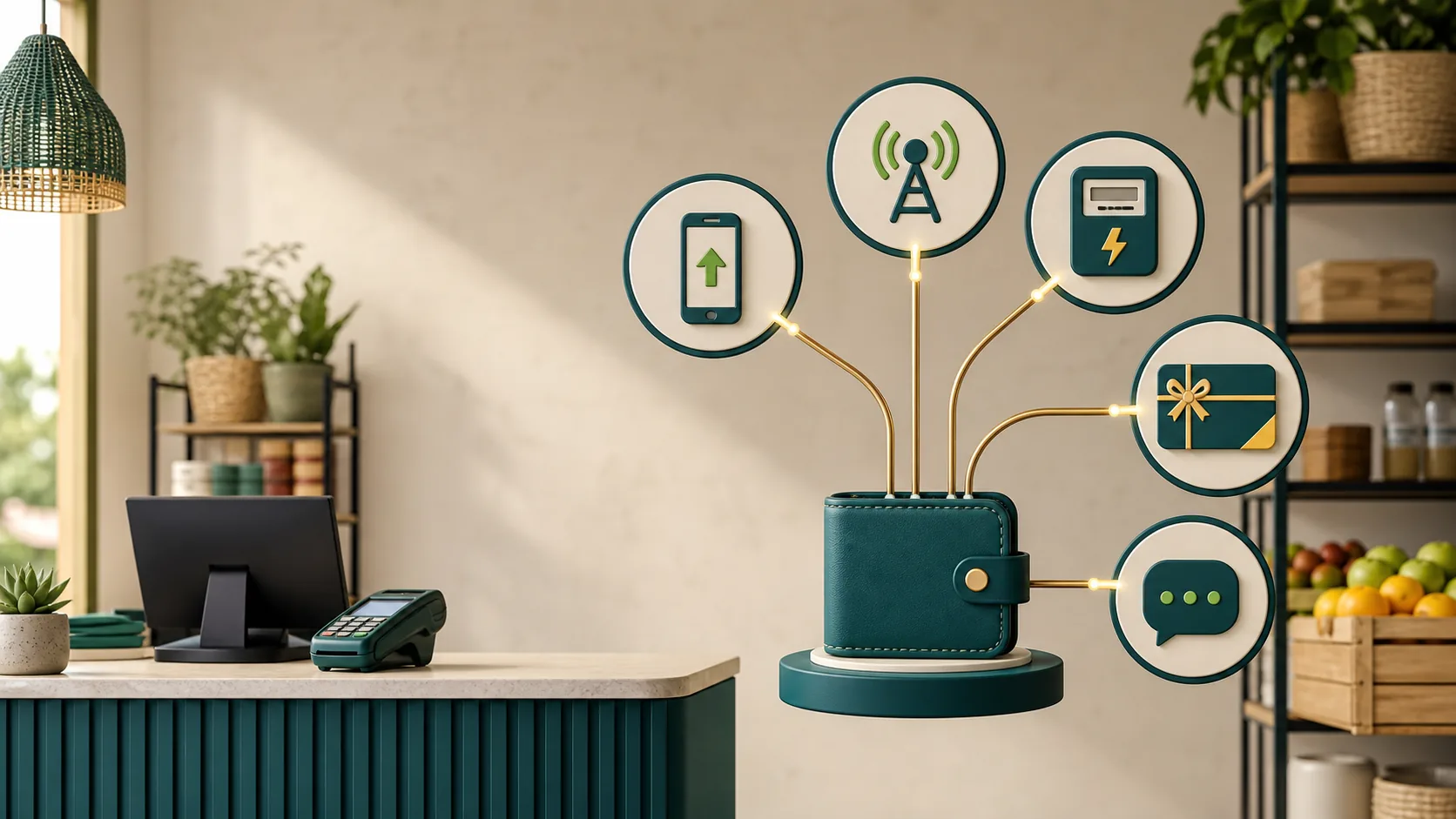
If you have ever bought airtime at a till, paid for electricity at a spaza shop, or received a grocery voucher on your phone, you have used a VAS product. VAS stands for value-added services, and behind the jargon sits one of the simplest business ideas in South Africa: everyday digital products that any business can sell or use, without holding stock, without a warehouse, and without anything physical changing hands.
This guide explains what VAS products are, how the money works, and the three ways a business can start offering them, in plain language.
The simple definition
A VAS product is a digital product delivered instantly: a code, a token, a recharge or a message that arrives the moment it is paid for.
The name comes from retail. A shop that sells bread and milk adds airtime to the till, and the airtime "adds value" to the shop: customers come in for a R10 recharge and leave with bread too. The name stuck, and today VAS describes the whole family of instant digital products, whether they are sold at a till, from a website, or delivered automatically by software.
The important part is what VAS products have in common:
- No stock. There is nothing to store, ship or run out of. The product is created at the moment of sale.
- Instant delivery. The recharge lands on the phone, the token loads the meter, the voucher arrives by SMS, within seconds.
- Everyone needs them. Airtime, data and electricity are not luxuries in South Africa. They are groceries.
The main VAS products, one by one
Airtime. The original VAS product. A recharge loaded directly onto any prepaid number on Vodacom, MTN, Cell C or Telkom. Businesses sell it to customers, or load it onto staff and customer numbers as rewards or work allowances.
Mobile data. Network-specific bundles delivered straight to a number. Data has overtaken voice for most households, which makes it both a strong seller and a practical staff benefit. The one catch is that bundles are network-specific, so you check which network a number is on before sending.
Prepaid electricity. A 20-digit token generated for a specific meter, entered on the keypad, and the units load. It is the fastest-growing VAS category because nearly every household buys it monthly. If electricity tokens are new to you, our complete buying guide walks through the whole process.
Gift vouchers. Digital vouchers for retailers like Checkers, Shoprite, Pick n Pay, Woolworths and PEP, delivered as a code. Businesses use them for staff rewards, customer incentives and employee food support; consumers use them as gifts that arrive instantly. The full voucher guide covers the catalogue.
SMS. Slightly different from the others because it is a message rather than a product, but it lives in the same family: instant, digital, delivered to a phone. Businesses use bulk SMS for order notices, payment reminders and approved customer communication.
How the money works
VAS runs on a wallet model, and once you understand it, you understand the whole industry.
- You load a wallet. You deposit money with a VAS provider. That balance is your float.
- Products are sold from the wallet. Every recharge, token or voucher you issue is deducted from the float at the moment of sale.
- Your margin is the discount. Providers sell most products to businesses at a small percentage below face value. You issue R100 of airtime, the wallet is debited slightly less than R100, and the difference is yours. Margins per transaction are small, which is why VAS is a volume game: a shop selling airtime a hundred times a day earns real money from it, and so does a platform processing thousands of recharges.
- Everything is logged. Because every product is digital, every sale leaves a record: what was issued, to which number or meter, when, and what it cost. Reconciliation is a report, not a stocktake.
Two practical notes. First, watch out for fees: some providers charge monthly platform fees or per-transaction fees that quietly eat the margin. Second, the float is your inventory; running it dry at month end, when everyone buys electricity and airtime, is the VAS equivalent of empty shelves.
Who actually uses VAS products
Shops and resellers. The classic case: a spaza, salon, internet cafe or garage adds airtime, electricity and data to what it already sells. Customers who come weekly for a recharge become customers for everything else.
Ordinary businesses, for their own operations. This is the use case people overlook. A company with drivers loads data onto their phones monthly instead of paying cash allowances. HR sends grocery vouchers as year-end gifts. A landlord buys electricity for twelve meters in one batch. None of them are "selling" VAS; they are using it as operational plumbing.
Developers and platforms. Apps, fintechs and websites that build VAS into their own product through an API: a stokvel app that pays out in vouchers, an ISP that bundles data, a rewards platform issuing airtime automatically. If that is you, start with the API integration guides.
Three ways to plug in
Every VAS provider worth using offers the same three doors, in increasing order of automation:
1. A web portal. Log in, pick a product, enter a number or meter, done. Right for occasional use and small volumes. You can be issuing products ten minutes after opening an account.
2. Bulk uploads. A spreadsheet with one row per recipient, uploaded as a single batch: airtime for a staff list, data for a fleet of devices, electricity for a block of flats, vouchers for a whole team. Right for anything monthly and repeatable.
3. An API. Your own software creates orders automatically, whenever your business logic says so. Right for platforms, apps and any process you never want to touch by hand again.
The healthy path is to start at door one and move right as volumes grow. Nothing about the wallet or the products changes; only the level of automation does.
How to choose a VAS provider
The checklist that matters, whatever provider you look at:
- All four networks for airtime and data, not a subset.
- No monthly fees. The margin is thin; a platform fee can erase it.
- Real reconciliation. Per-transaction records you can export, not just a balance.
- Wide electricity coverage and a way to verify a meter before you pay.
- A live product catalogue. Bundles and voucher values change; the platform should reflect what is actually available today, not a stale price list.
- A growth path. Portal, bulk and API on the same account, so scaling up does not mean starting over.
- Human support. When a token query happens at 7pm, a phone number beats a ticket queue.
SIMcloud was built against exactly that checklist: airtime, data, electricity, vouchers and SMS from one wallet, no monthly fees, and the same account working across portal, CSV bulk uploads and the API.
FAQ
What does VAS stand for?
Value-added services: instant digital products such as airtime, data, prepaid electricity, gift vouchers and SMS, sold alongside or inside another business.
Can a small business sell airtime and electricity?
Yes. Open an account with a VAS provider, load a wallet, and sell from a web portal the same day. No licence is required to resell prepaid products through a provider, and there is no stock to buy upfront beyond the wallet float.
How do you make money selling VAS products?
Products are supplied at a small discount to face value; the discount is your margin. Individual margins are small, so the businesses that do well treat VAS as a volume product and a footfall driver rather than a big-ticket item.
What is the difference between VAS and a payment service?
A payment service moves money; a VAS platform delivers a product. When a customer buys electricity, the payment is only half the transaction; the VAS side generates the token for the right meter and delivers it.
Do I need a developer to offer VAS products?
No. The portal and spreadsheet routes need no technical skills at all. An API integration needs a developer, but it is optional and can come later on the same account.
See it for yourself. Create a free SIMcloud account, load a small float, and issue your first product in minutes. No monthly fees, all four networks, one wallet for everything.